Val Muller

The Electronic Wordsmith

For various reasons, I was not going to read this book. But then my dad bought a copy, read it, and wanted me to read it to see what I thought of it.

First: To Kill a Mockingbird. I enjoyed the book immensely. It a favorite “school book” of my childhood (in other words, a book we were “forced” to read that I actually enjoyed). I did a presentation for Birmingham Schools on how to integrate elements of the movie version into lesson plans that encourage critical thinking. I did not want to read the “newly-discovered manuscript” lest my view of the original work become compromised. What I like about the original is that it stands on its own, and it’s concise the way classics are concise. It carries a strong theme, and the characterization and other plot elements work consistently toward that end. It’s concise, but one could read it again and again and discover new things.

As I began reading Go Set a Watchman, my opinion (on not having wanted to read it) did not change much. The novel seemed to meander a bit for me. I didn’t start getting interested until around page 75 (out of nearly 300), and it wasn’t until about page 125 that I actually sort of felt like reading it. Luckily, I was reading it in the two days before Christmas (so I could return it to my dad), so I was on a timeline to get it finished.

Part of the problem was point of view. The point of view seemed to change randomly at times. Just when I would start to settle into one perspective, the POV would seem to jump. I understand this is an artistic choice, but it was odd to me. Then there were lines that changed to first-person present tense—obviously to show what Jean Louise (Scout) was thinking, but the transitions were awkward, as they happened mid-paragraph. I suppose some books change to italics to denote a character’s internal thoughts. Maybe that would have helped allow me to read more quickly.

(In fact, talking to someone who had listened to the audio book version after having read the book noted something similar: when the actress read certain lines, it became apparent that they were internal thoughts.)

Despite my initial tepid reception, I did enjoy Lee’s language—great word choice, imagery, and figurative language. I enjoyed finding these gems scattered throughout. But then, a freedom theme and a theme of limited government appeared, and I finished the rest of the book in one afternoon.

The rest of this review will contain some spoilers, beginning with a quick synopsis.

(Spoilers follow)

The premise: The book takes place when Jean Louise Finch (Scout) is 26 years old. She has been living in New York City and returns to her Southern hometown of Maycomb (the setting of To Kill a Mockingbird). There, she discovers that her father is aging, and life is not what she remembered it.

Without giving too many spoilers, Jean Louise has to reconcile her life in New York City with the tension she discovers in her hometown—even among family—regarding Civil Rights and racism. Even her beloved Cal (Calpurnia, her childhood nanny) no longer treats her as a friend because of racial tensions. Specifically, she attends a community improvement meeting in which her father introduces a blatant racist to be the guest speaker. Jean Louise is further irked by the fact that her boyfriend—someone she’s seriously considering marrying—is also at the meeting (as are most of the men she had grown up respecting).

I understand that this manuscript was rejected in favor of a rewritten story—what became To Kill a Mockingbird. I much prefer the original, though it was interesting to see how all the characters seem to mesh together with the perspective of the original in mind. I wonder if Harper Lee kept these characters’ futures in mind as she wrote the original—or if she scrapped some of what she had mentally planned in favor of a simpler, more clean message in the original classic. But this book did strike certain chords with me in terms of my love for freedom, limited government, and individual responsibility.

In some ways, parts of the complexity of the characters reminded me of something Ayn Rand would write (only much, much, much shorter!). For instance, when Jean Louise couldn’t reconcile all those people she saw at the racist meeting, I kept hearing Francisco’s voice from Atlas Shrugged say, “Check your premises.” Many of the people Jean Louise had trouble “getting” were patient with her, in some ways allowing her to figure out the discrepancies for herself. Here is Atticus Finch, practically a god to her, and he is attending a meeting led by a racist. What gives? It’s up to Jean Louise to figure it out.

While she’s working through her father’s fallibility, she learns that his racism (though it exists and is arguably a side-effect of the time period) was at first overstated, and he is trying to keep his version of government alive.

It was here—when the characters began talking about an overreach of government (the book was written in the 1950s) that the book truly captured my interest. Atticus (and others) emphasized that people should be responsible in voting and in acting—and that citizenship should in some ways be earned before being able to vote. I can’t help but agree: otherwise, what’s to stop people from voting their own benefits? Many characters had problems with the NAACP in the novel and the way it was using the federal government to strong-arm society into simply doing things without building the supporting structures needed to support a new way of life.

This is, naturally, a complicated issue, and Jean Louise does not see the solution as “clear-cut” the way her father does. She does have a problem with the way the federal government is dictating people’s lives, but she also sees the good in the Civil Rights laws that are being passed. I could not help but consider my own libertarian-leaning views that believe it’s better to leave people free to make their own decisions—change will thus happen naturally and in a free-market with no coercion or spite involved.

My absolute favorite passage, and what made the book worth reading for me, is the discussion that Jean Louise starts with her uncle on page 197. She is concerned about what appears to be rampant racism going on in her hometown, and her uncle (albeit, in a roundabout way at first) explains that the Civil War and the emerging resistance to Civil Rights is actually about identity—and he begins talking about how the government is starting to help those who are most dependent on it—essentially buying loyalty. Uncle Jack says, “I’m a healthy old man with a constitutional mistrust of paternalism and government in large doses..the only thing I’m afraid of about this country is that its government will someday become so monstrous that the smallest person in it will be trampled underfoot” (198). I shivered, thinking of things like the NSA and the TSA and wondering what recourse we would actually have in our broken system if the government actually did want to act against its citizens.

Later, Jean Louise and her father discuss the Supreme Court case and Jean Louise’s perception of the importance of the Tenth Amendment (the one limiting the powers of the federal government and relegating them to the states and the people). Here, Jean Louise turns into the Scout I remember from To Kill a Mockingbird returns, speaking to my heart:

“I don’t know much about government and economics… but I do know that the Federal Government to me, to one small citizen, is mostly dreary hallways and waiting around. The more we have, the longer we wait and the tireder we get.. instead of going about [fixing the system] through Congress and the state legislature like we should, when we tried to do right we just made it easier for them to set up more hallways and more waiting.” (240).

Atticus responds with the fiery vigor I expected of him the whole time: “You mean because the Court said it we must take it? No ma’am. I don’t see it that way. If you think I for one citizen am going to take it lying down, you’re quite wrong. As you say, Jean Louise, there’s only one thing higher than the Court in this country, and that’s the Constitution.” (241).

And there is the crux of the paradox. Jean Louise understands that racial equality is a great cause, but she is bothered by the fact that the federal government is overreaching its powers and imposing its will on the people. And in the name of a legitimately great cause, the people have fed the monster that becomes the government. Bureaucracy has a habit of outgrowing itself (in The Grapes of Wrath, Steinbeck called it a “monster” that man could no longer control), and during the time of Civil Rights in the South, Harper Lee visits the issue of balancing limited government and moral rights.

In the end, this is why Jean Louise is asked to stay in Maycomb rather than return to New York. She is intelligent enough and conflicted enough to see the need for both equality and limited government—and understand the difficulty in balancing the two in a natural way that isn’t divisive.

In many ways, we seem still to be battling this issue. With countless pages of legislation that no one will ever read, you could be inadvertently breaking a law right now—right this minute—and not even know it. It’s probably true that said law has (or had, at one time) a morally-righteous purpose for being written. But that’s a moot point—when something is imposed on you, you’ll be more prone to resent it and resist it the same way the people of Maycomb resisted change during the time of Civil Rights.

Happy Christmas!

This year, so many people are complaining about the difficulty of getting into the Christmas spirit when the weather is hovering around 70 degrees across the East Coast.

I don’t share that problem. I have no issues wearing sandals and having open windows while the Christmas tree is glowing against the backdrop of Christmas music blaring on the radio.

Nonetheless, I still enjoy spending Christmas Eve (and Christmas night, if I’m able to stay awake) sitting on the couch and watching Christmas movies. Regardless of the weather, they always help me feel a bit more Christmassy. (Though I would argue that my definition of “Christmassy” is probably not typical!)

So today, I thought I’d share my top five Christmas movies (in no particular order).

  1. A Christmas Story. This movie is usually on for 24 hours straight on Christmas Eve, and I watched it one year while home with the flu for almost all 24. The movie has a classic feel that makes it seem older than it actually is. I like how the humor mixes in with typical holiday spirit. I also feel that the filmmaker worked hard to keep a literary feel to the narrator and make effective use of each scene. If you’ve never seen this film, you’ll probably appreciate the nostalgia and creativity as we see the world through the eyes of a young boy. I enjoy that the family portrayed is far from perfect.
  2. How the Grinch Stole Christmas (the cartoon version—yes, I know it’s not technically long enough to be considered an actual movie). I don’t know how many times I watched this on TV over the years, and now I have it on DVD. It almost seems like a cliché now, but it’s definitely found its place in the cannon of Christmas videos. I’m sure I don’t need to summarize about the Grinch and his nemeses, but there’s something uplifting about the people of Who-ville coming together and singing on Christmas morning even after the Grinch has stolen their things. It always made me think about what was truly important on Christmas rather than focus on all the gifts that were so exciting as a kid.
  3. Gremlins. As a kid, my sister and I were obsessed with Gizmo. We loved how cute he was, and we liked the forbidden nature of the rules: avoid exposing him to bright light, don’t get him wet, and don’t feed him after midnight. There’s something magical about those rules, and despite the bloody mess that follows the main characters, I love worlds in which magic simply makes sense. Re-watching the film this year, I forgot how violent some of the scenes are (for instance, the protagonist’s mother at one point throws a gremlin into a blender!). Even so, the film is not blatantly bloody, and the gremlins inject enough humor into the narrative to keep it relatively light. And once again, the family is far from functional, and the Christmas is far from stereotypical.
  4. The Nightmare Before Christmas. I loved this movie ever since I saw it in the theatre. It makes use of my favorite holiday, Halloween, while still blending in a little bit of that “Christmas magic” (without going over-the-top). The songs are instant classics, and the creepy nature of Halloween Town never truly leaves the story, even when we’re fully immersed in the Christmas aspects of it. As an example—there is a scene in which the US military tries to shoot down protagonist Jack as he rides through the sky pretending to be Santa. The film is so imaginative that it’s as if my childhood musings were transferred right to the screen. I usually watch this one between Halloween and Christmas.
  5. Krampus. This is a new one this year. I saw it in the theatre a couple of weeks ago. It’s rated PG-13, but it definitely fits into the horror genre (albeit mild horror). The premise: Krampus is an old legend about a magical creature similar to Santa, only opposite—in that he seeks out naughty children and punishes them, with brutal and deadly force. What I enjoyed about this movie is that it didn’t take itself too seriously. There were moments of humor in it despite the grim nature of the narrative. It’s definitely a movie to avoid if you like those classic Hallmark-style films; but for me, I enjoyed the fact that the movie acknowledges that Christmas is not immune to nightmares. The DVD is already on my Christmas wish list for next year.

Regardless of your preference of film or video, I above all am thankful for the resources, security, and time to be able to enjoy at least one Christmas movie each year on Christmas Eve. There’s a lot to be thankful for in life, and not many of those reasons fit under the tree.

"But *I* fit under the tree!"

“But *I* fit under the tree!”

Wishing you a Happy Christmas and a Healthy, Happy New Year!

Welcome to the Spot Writers. The prompt for this month is to use these words in a story or poem: star, pine bough, glass bulb, mistletoe. (There is one more word we must use, but Cathy will reveal that mystery at the end of the story.) This week’s contribution, “The Christmas Wreath,” comes from Cathy MacKenzie.

Just in time for Christmas, check out Cathy’s new publications: Her children’s picture book, BAD, BAD GRANNY, and Volume 4 of the “Creepy Christmas” series of books, CREEPY CHEERY CHRISTMAS, available on Amazon (print and e-book) and Smashwords (e-book).

***

The Christmas Wreath

by Cathy MacKenzie


Ellie skipped along the path and came across her mother. “What are you doing, Mum?”

“I’m making a Christmas wreath. You arrived just in time.”

“Those are such pretty ornaments. I love the glass bulbs, so colourful. But green is my favourite, and you don’t have any green.”

“Green’s my favourite, too, but green bulbs aren’t as striking on pine boughs. These reds and whites will be beautiful, especially when the light hits them. I’m lucky I was able to scavenge these.” Mother examined the pile of bulbs. “Do you think they’re too big?”

Ellie scanned the bulbs and the pile of fresh boughs. “The pine branches are big, too. It’s all in the proportion, isn’t it?”

“I do believe you’re right. Can you help me lift them? If you take one end, I’ll take the other.”

Ellie and her mother grasped one of the boughs. “One, two, three—heave,” Mother said.

Mother and Ellie managed to move the boughs onto the makeshift table.

“I need to shape the wire into a circle. Hold here.”

With Ellie’s help, Mother formed the wire into a large circle. Together they wove boughs around and around the wire.

Ellie pointed at some loose greens. “What’s this?”

“That’s mistletoe.”

“Mistletoe?”

Mother smiled. “It’s a kissing plant. I’m going to drag your father under it and kiss him to death.”

Ellie gasped. “To death?”

Mother laughed. “Not literally. I wouldn’t do that.”

She examined the half-finished wreath and sighed. “This is going to be big, isn’t it? Your father will have to help hang it.”

Ellie and her mother finished the wreath, which did indeed turn out larger than Mother had planned, certainly the largest wreath Ellie had ever seen.

When Father arrived home, he said he’d round up several friends to help. “You outdid yourself,” he said.

Mother blushed and bowed.

Father left, soon returning with three friends. Carefully, they managed to transport the wreath to where Mother wanted it. “There,” she pointed. “Hang it in the centre. And make sure the bow is even and the ribbons hang straight.”

The four males grunted and groaned but hung the wreath as Mother had instructed.

After Father’s friends left, Father, Mother, and Ellie gazed at the wreath positioned perfectly on the trunk of a large oak tree. The sprig of mistletoe dangled from the centre of the crisp, red bow. The moon smiled upon the bulbs, making them glisten and glow like electric lights. A lone star twinkled in the distance.

“Is that the star of Bethlehem?” Ellie asked. No one answered. Mother had already grasped Father’s hand and was leading him closer to the tree.

Ellie averted her eyes while they kissed. Not wanting to wish her life away, she’d only ever dreamt of a fellow elf to love. Her time would come soon enough.

She glanced back at her parents, who had broken away from their embrace.

“Merry Christmas!” Ellie shouted. “And a Happy New Year!”

***

***(Have you guessed the mystery word? Scroll to the bottom.)***

***


The Spot Writers—Our Members:

RC Bonitz: http://www.rcbonitz.com

Val Muller: https://valmuller.com/blog/

Catherine A. MacKenzie: https://writingwicket.wordpress.com/wicker-chitter/

Tom Robson: website in progress


ELF!!

I was honored last week to attend the holiday party/December meeting of my local writers’ group, where I was surprised with a basket of books for the Little One. Each member of the group brought a children’s book to share with me, and as the note said, establish the baby’s first library.

"Starting Baby E on her first library!"

“Starting Baby E on her first library!”

I’ll admit that the nursery was looking a bit sparse until then. There’s just something about a basket of books that makes a room feel lived-in and inviting.

A grateful thank-you goes out to all my writer friends. I look forward to instilling a love of reading in a new human being come February.

Not sure what story I'm telling, but I'm telling something!

Not sure what story I’m telling, but I’m telling something!

To end on a humorous note, perhaps the most entertaining book gift this week came from a colleague in response to my comment that the Little One was being especially squirmy at night, awakening me in the wee hours and making for long days. She told me I could start reading it to my belly to see if it puts the Little One to sleep–and she even gave me her own personal copy 🙂

Yes, this is a real book. If you search YouTube, you can actually find Samuel L. Jackson reading it!

Yes, this is a real book. If you search YouTube, you can actually find Samuel L. Jackson reading it!

Baby book photos courtesy of author Sandra Stein. Check out her books on her Amazon page!

Welcome to the Spot Writers. The prompt for this month is to use these words in a story or poem: star, pine bough, glass bulb, mistletoe. This week’s tale comes from Val Muller, author of the Corgi Capers kidlit mystery series and the YA reboot The Scarred Letter.

The Elf Who Taught Kindergarten

By Val Muller

We’ve all heard the story of the elf who wants to be a dentist, and surely there’s nothing worse than being stuck in the wrong profession. But have you heard the tale of the elf who was stuck teaching kindergarten? You haven’t? Well then pull up a mug of hot chocolate—extra marshmallows and candy cane stirrer—and get ready!

Graduating from North Pole School,

Alice the Elf was sure no fool.

She sought her counsellor’s sage advice

For what career might just suffice.


“You’re born to teach,” the counsellor said.

Alice frowned and scratched her head.

“Not sew or build some children’s toys,

For all the good little girls and boys?


“Isn’t that what we were trained for?”

But the counsellor simply showed her the door:

“Go teach the young ones, Alice Elf,

And see how rewarding it can be for yourself.”


So Alice applied to Public School

And passed her Praxis and learned the rules.

She was hired in no time at all

To a Kindergarten classroom, starting that fall.


She did okay the first two months,

But her tired eyes gave her a hunch

Of just how tough the year would be.

She missed the snow, the toys, the trees…


So she decked her class in mistletoe,

Electric lights, and fresh pine boughs.

She hung glass bulbs, a glowing star—

The brightest room in the school, by far.


The kids all swooned in such delight

To see Alice Elf’s magic lights.

They learned their lessons with captive glee

Under the twinkling lights of the tree.


But then the principal came for a check.

She hemmed and hawed and clawed her neck.

Her eyes flashed hard at Alice’s blunder.

“You can’t have holiday décor in October!”


Poor Alice’s lips trembled as eyes teared.

The children cried in saddened fear.

They liked their Christmas kingdom bright

Like guiding star in dark of night.


The principal an exception made

But to young Alice the advice she gave:

“Take down the décor in January, stat!”

Alice nodded, and that was that.


January came, the décor stayed lit.

The principal had another fit.

“Take it down, or I’ll do it myself—

What do you think: you’re Santa’s elf?”


Alice nodded, and the principal left,

Leaving Alice sadly bereft.

But she remembered snow and Northern pole

And she left the lights up for another go.


In February, the school was decked

In red, pink hearts and all the rest.

In March the clovers and pots of gold

Captivated children’s souls.


But not so in young Alice’s room.

Her Christmas décor seemed a bit like gloom.

“How come the decorations never change?”

Asked her students (the room did look deranged


To display stars and snow and lights

When other rooms wore flowers springy and bright).

Alice shrugged: “Christmas is best.

With decorations all year, we’ve all been blessed—


“At least, that’s how it is at the North Pole,

With 24/7 spent under feet of snow.”

At the school year’s end, each class was shaded

In suns and sand, dreams of vacation…


Except for Alice’s room down the hall,

Which still showed angels, shiny glass balls.

And the principal arrived with a bright pink slip

And a box for Alice—to take a trip


To the North Pole or the next public school.

“Christmas all year simply breaks the rule.

You’re no longer welcome here,

Alice the teacher, my misguided dear.”


A call to the counsellor gave Alice bad news:

The North Pole didn’t have openings at any schools.

So she applied to the district right down the street,

And they were eager for teachers to meet and to greet,


And they hired young Alice right on the spot

And smiled when they saw the decorations in her box.

“Christmas already, and only in June?”

She smiled at them and said, “It’s never too soon!”


And so they showed her the classroom she’d take in the fall,

And she set it all up with lights and glass balls,

And it twinkled in June’s bright, hot sun.

And she smiled to think of next year’s Christmas fun.


~*~


The Spot Writers—Our Members:

RC Bonitz: http://www.rcbonitz.com

Val Muller: https://valmuller.com/blog/

Catherine A. MacKenzie: https://writingwicket.wordpress.com/wicker-chitter/

Tom Robson: website in progress


ELF!!


A coworker loaned me this coming-of-age story, telling me it is similar to The Adventures of Huckleberry Finn, only it’s a young woman (slightly older than Huck) in slightly more modern times. It was an apt description. Margo lives in rural Michigan, and the book takes place in the 1970s. Whereas Twain wove humor as a major force in his novel, Campbell uses sexuality. Because I was in a weird place in my life when I started reading it, I picked it up this summer and then forgot about it; I found it and finished reading it a few days ago.

It wasn’t a slow read; I just felt that the plot meandered a bit, with Margo drifting from one place to another without much in the way of parental influence (her dad was killed; her mother abandoned her at her most vulnerable). Still, that’s what happens in Huck Finn: as in any coming-of-age tale, the protagonist must find her way without the guidance of an overpowering and responsible adult. Once I realized that this is a character-driven, not plot-driven, novel, I read it fairly quickly. But being honest, I didn’t get into the book until I was more than halfway done. I felt parts of it prior to that were intriguing, but I just didn’t “get” what was happening yet and was wondering if the plot was going anywhere.

This book is for a slightly older crowd than Twain’s classic. There is rape, sex, and shooting—and the consequences of the above. Margo aspires to be Annie Oakley, making a living off her trick shooting while living off the land. She seems ill-equipped for the modern world. For instance, when she does find her mother living in a relatively suburban neighborhood, she spends the night. But unable to sleep indoors for so long (like Huck), she sneaks out to the backyard to build a fire, prompting an alarmed neighbor to call her mother to report a vagabond living in the back yard.

Throughout the novel, her tenacity to stick to the old ways is both an asset and a liability. Many find her attractive; some call her a river princess, or nicknames to that effect. I did enjoy the way she sticks to the old ways, seeking people who live in unconventional ways. I often ponder the numerous ways I—and most people—give in to the predominant lifestyle simply because it’s what is accepted. How many of us would attempt today to live off the land or live off the grid?

Margo’s personality and decisions are reminiscent of an earlier America, the America Huck Finn was trying to keep a hold on—one full of much less bureaucracy and fewer rules, but one that was slipping away from Huck even during the 1800s. A few times, I got annoyed at Margo, wondering why she couldn’t just accept conventional help and try to live the way society wanted her to live. But I’ll admit, as I was reading the book, I began to get mad at myself for thinking that. Here is a strong character who wants to live her way on her terms. How much different would the world be if we all had even just a hint of her gumption?

Though this is a coming-of-age novel, I am not sure I would have fully appreciated it while I was an adolescent. I needed the perspective of a (sometimes) fully-grown adult to appreciate the way that all the characters, adults and youth alike, make their own decisions based on their life experiences and assumptions. I would be interested to learn how male readers reacted to the book. So many of the men Margo encounters, or has relationships with, seem like they are just placed in the book as a step to help Margo grow and are not necessarily admirable role models (though neither are the women!).

Flash Fiction:

No comments

Welcome to the Spot Writers. The prompt for this month centres around the theme of autumn (Halloween, crispy leaves, Thanksgiving, a chill in the air, the smell of smoke in the wind—even early Christmas sales). This week’s contribution comes from Tom Robson.

A Lost Season?

By Tom Robson

The Autumn of 1926 began disastrously for Fred.

September. A change of season. For some the climatic transition is less significant than that other seasonal change. They can ignore the Autumn colors as the trees display their reds, oranges and yellows. Cooling temperatures are to their liking, though they don’t enjoy too much rain or the threat of an early winter. Good weather for football should last through till December. Autumn welcomed English football. The gulf stream might encourage an Indian summer which could bring good, dry weather well into November. Winter was months away, with time to acclimatize for new year winter football games. The climatic season was unfolding as it should. but the prospect of football for Fred was fading fast.

Fred was now in his fifteenth year. It was no longer an Autumn necessity to find those particular trees, a tramcar ride away in Oakwood. There, for years, he and his sisters had collected the chestnuts which their mother roasted over the open hearth of their dining room in the ensuing colder evenings. He was long past finding that other chestnut tree, the one that yielded conkers, Horse Chestnuts. He no longer cared about the ritual and competition of that childhood game. Yet it didn’t seem too long ago that he gloried in having a “ two hundred and twenty sevener conker,” best on the school playground that October, as the conker season gave way to marbles.

September wasn’t “back-to-school” any more for Fred. He was finished with that. September didn’t initiate school or Autumn for him. September was the end of the cricket season. More significantly football had re-commenced, and football was the most important thing in Fred’s life.

He lived for football. Why couldn’t his father understand that? Why had he banned any football for Fred, except on Saturday afternoons? Didn’t he know that wasn’t enough? You had to practise in the week, between games, to stay on a team. Fred’s football season was lost.

Last year, his father had been so proud when his youngest son had been selected as right back in the all-city schools’ team that had beaten Huddersfield and then won again in Bradford. But that was back in the Spring when Fred was too young to see beyond the sheer enjoyment of a game he loved and succeeded in. Autumn marked the start of a new season and he needed a team. He was fourteen and out of school. Already six feet tall and beginning to fill out, skillful and a redoubtable defender, he needed to go for try outs. A couple of scouts for teams in the Yorkshire Football league had talked to him about that. One had approached his father, saying that Fred had a possible future as a professional.

“ I showed him the door, young Fred.” pronounced his father next morning at breakfast. “There’s that apprenticeship waiting for you at Tyndale’s as soon as you’re sixteen. That’s your future. A trade’s better than playing a game. There’s no future in that, lad! You’re washed up at 30.”

“But…..”

“But nothing!” interjected Tom Robson. “You can play Saturday afternoons, but that’s it!”

Fred knew better than to argue with his father. He might be the “baby” of the family and, as his siblings frequently proclaimed away from their parents’ hearing, “spoiled rotten,” but father’s word was law. Fred’s season was gone. Fred’s football future was kickabouts on a Saturday with those who weren’t good enough to make any team.

All this had happened in late summer; weeks ago. Fred had since met up with his footballing friends who urged him to sneak away to play. Some even suggested he try out for some of the better teams like the Amateurs or Farsley Celtic. If he made it then his father would have to change his mind, wouldn’t he? What else was Fred going to do until he was sixteen and could start at Tyndale’s? There was no paid work to be had in Leeds, in 1926

“Father wants me to do some work on the properties he owns. He wants me to help out at home. You don’t know him. He’ll never change his mind,” was Fred’s response.

But last Wednesday, when he was supposed to be cleaning up one of the Albion Place houses before it was rented out, he had sneaked his boots and the rest of his kit into his toolbag. He’d worked like crazy all morning, then taken the tram, past his Harehills stop, up to the Soldiers’ Fields at Oakwood. . It was afternoon, open try outs for Yorkshire Amateurs. Fred changed, signed in, was put on a team and felt he did well.

He wanted to get home before his father. He got off the tramcar near home but, as luck would have it, his father saw him step down, coming from the wrong direction, still wearing his football shirt. They marched together up Harehills Lane to home where Tom Robson took his son’s precious football boots out of the toolbag and deposited them in the dustbin. He didn’t say much. He didn’t have to.

Jane Robson tried to console her youngest, but her message was “father knows best.”

It was Fred’s much older brother Harry, visiting the next day, who gave Fred some hope. When Fred arrived home, from a full day cleaning and painting at Albion Place, he was surprised to see his brother.

After greeting Harry, who was home on leave from the navy, Fred had to share his distress. “Did you hear what dad did?” he asked.

“I did, Young Fred! Mother told me. I’ll see what I can do. I’ll talk to him,” consoled Harry.

“But will father listen to you? Does he ever change his mind?” Fred wondered aloud, actually smiling at the older brother he so looked up to.

“I can try, our Fred. Now go and look behind the mangle in the kitchen. I think that’s the safest hiding place. Father never goes out there.”

Fred walked through the door and down the couple of steps to look behind the machine whose rollers squeezed the water from the wet clothes on laundry day. There were his boots, rescued by Harry from the trash.

“Thanks Harry! But are you sure? Can we get away with this?” questioned Fred, seeing his football season possibly returning.

“Nay, lad. But I can ask. Better I argue your case than you. Father might just listen to another grown up.”

Fred went up to his room right after supper. His mother asked if he was unwell. He wasn’t, but he needed to give Harry a chance to talk to their father.

He was deep into his book when his father’s voice came up the stairs. “Fred! Get down here a minute. We need to talk.”

The tone was not very positive, but it was the same tone he used whenever he talked to his youngest. Fred hurried down. Harry and his father were sat either side of the fireplace, sipping tea. Fred’s mother poured one for Fred and turned towards her kitchen.

“No, mother. Will you stay a minute to listen to this?” requested her husband.

Mother and her youngest son sat. Tom Robson, checked his pocket watch; an excuse while he searched for the right words. Fred fidgeted in the chair, not knowing where to put his too long legs or restless hands.

“Our Harry has told me a few things I hadn’t realized about you and football, our Fred,” began his father.

Fred glanced in Harry’s direction, catching a hint of a smile on his brother’s face.

Choosing his words carefully, their father continued, “I think, mother, as long as Fred here does the work that you and I set him, he can play football on Saturdays and in the week, as long as it not too often and he asks first. What do you think?”

Fred turned to look at his mother, a pleading look etched on his face.

“Whatever you say, dear, as long as he doesn’t take advantage.”

Fred could contain himself no longer. “I won’t mum! Honest! I’ll always ask first if I need to play in the week – or practice. And if there’s too much work to do then I’ll do it. I’ll even miss football if you say so.”

“Whoa our Fred! I’ve not finished yet,” said his father, interrupting Fred’s outburst. “That’s this year, but once you start at Tyndale’s, when you’re sixteen, then football comes third. First there’s your responsibilities here. Next is Tyndales. Third comes football. “ He paused before asking, “Now what do you think?”

Fred’s fifteenth birthday was still seven month’s away. He had two football seasons before he reached sixteen and the start of his apprenticeship. That was ages away. He didn’t need to think.

“Thank you for this, father. And you mum!” Fred was almost lost for words he was so excited.

“First Chore, Fred.” said his father. “Go rescue those football boots from the dustbin.”

Fred looked over at his brother. He realised what Harry must have done to change their father’s mind. He held out his hand to Harry, who grasped it and pulled him into a bear hug, whispering, “I put the boots back. Go find them! ”

“Thanks for what you did, Harry.” was Fred’s afterthought, as he hurried to retrieve his football boots from the dustbin.

Fred’s lost September season had been saved.

For the next ten seasons, until he married and work commitments interfered, Fred played for various Farsley Celtic’s teams, always at right back. Early on he was approached to become an apprentice professional with Leeds United. He didn’t need to discuss it with his father. Tyndale’s offered a better future.

When his apprenticeship finished, Tyndale’s fired him rather than pay him full wages as a millwright. It was the depression.

Overseas, as a soldier in the second world war, Fred sometimes wondered if his life would be different had he become a professional football apprentice in the Autumn season he was sixteen.

Almost ninety years later, Fred’s son and his grandsons across the ocean, still see the Fall as the change of sports seasons.


The Spot Writers—Our Members:

RC Bonitzhttp://www.rcbonitz.com

Val Muller: https://valmuller.com/blog/

Catherine A. MacKenziehttps://writingwicket.wordpress.com/wicker-chitter/

Tom Robson: website in progress


Freedom is an important cause for me. I believe that with freedom, our potential for accomplishment becomes limitless. I’ve edited several anthologies with Freedom Forge Press on the topic of freedom, including both fiction and nonfiction stories about people striving to find freedom and celebrating the spirit of the individual.
I was happy to learn that for the next few days, Freedom Forge Press is running a sale on their ebooks–just $1.99 each. You can find the details at Freedom Forge Press’s site (click here for the post).

Here is a link to Freedom Forge Press’s anthologies on Amazon.com. (You can also find the same sale price on Freedom Forge’s novels as well!)

Welcome to the Spot Writers. The prompt for this month centres around the theme of autumn (Halloween, crispy leaves, Thanksgiving, a chill in the air, the smell of smoke in the wind—even early Christmas sales). This week’s contribution comes from Cathy MacKenzie.

Cathy’s latest children’s picture book, BAD, BAD GRANNY, is now available on Amazon, in print (in two sizes: 6×9 and 8×10) or e-book. Volume 4 of Cathy’s “Creepy Christmas” series of books, CREEPY CHEERY CHRISTMAS, has just been published. In fact, Cathy’s post this month is a story from that book titled, “Crows and Storks.” The book is available for purchase here, either on Amazon (print or e-book) or on Smashwords (e-book). Be forewarned, however. These “creepy Christmas” stories, depending upon your point of view, are either weird and wacky, crass and crude, humourous and sarcastic—or just plain silly!

 ***

Crows and Storks

by Cathy MacKenzie

“Let’s go shopping tonight, Bob.”

“Nah, I’m too tired.”

“Oh pooh, you’re just lazy. All you ever want to do is lounge around and drink beer in front of the TV.”

Bob’s eyes lit up. “Sounds like fun to me.”

“Come on, I want to shop, and I’d like some company. Maybe we could do a quick dinner out. Maybe take in a movie.”

“What’s all this? First you said shopping, now you’re talking dinners and movies and who knows what else.”

“Shopping, that’s it. Plus a quick, inexpensive dinner. Maybe a movie, I said. We could go to Curley’s in the mall. It’s pretty cheap.”

Bob tossed his paper to the floor and stood at attention. “Yes, ma’am. Whatever you say, ma’am. Let’s go. Onward ho. March: one, two, three.”

Elise threw up her arms. “Oh, Bob, quit being so dramatic. You’re exasperating. Forget I mentioned it.”

She stalked from the room. Seemed she’d been doing a lot of stalking from rooms lately.

Bob grinned. He never had any trouble exasperating his wife.

“Hey, Elise, okay, let’s go.” His voice boomed from the living room. “I can show you a few items I might like for Christmas.” He figured that was part of her plan, and two could play her game.

***

Bob parked the car in the mall parking lot, several spaces away from the nearest vehicle, which was his habit in case an inexperienced teenager or a foolish woman decided it would be a pleasant experience to gouge the side of his car.

Elise, like always, had removed her seatbelt before he had turned off the engine and had zoomed off like a speeding bullet toward the entrance.

“Sir, sir,” a voice bellowed.

Bob turned to see a woman hanging from the window of a passing truck. “Sir, you’re parked over the yellow line.”

His head swiveled again. “What?”

Elise, who had heard a commotion, turned to watch.

“What?” Bob repeated.

The woman pointed at his car. “You’re parked over the line. You’re taking more space than you should. It’ll be hard for another car to park beside you.”

Still confused, Bob looked back at his vehicle. “What the hell you yapping about?”

“Hey, buster, don’t talk to me like that,” the woman shouted. “I have a citizen’s right to report bozos like you who think the world owes them.”

By that time, Elise had returned to Bob’s side. “What’s wrong?”

Bob sighed. “Nothing, Elise. Go wait inside the mall while I move the car.”

Elise’s face lit up like an illuminated light bulb. “Oh, okay.” She made a face at the rear of the white truck when it pulled away. She would have flipped her finger but knew the woman wouldn’t see. And she didn’t want to exert herself unnecessarily; she needed to save her strength for shopping. And for dealing with her ornery husband.

What a weak sap he was. No gumption at all. What man listened to a stranger in a parking lot anyhow? But he’d make some excuse.

Elise entered the mall and stood by the double doors waiting for her husband. Where was the woman who had rudely admonished her husband? Would she pass by without Elise noticing her? Come to think of it, she hadn’t gotten a good look at the person and wouldn’t recognize her if the woman fainted dead beside her. After further thought, she wished she had a voodoo doll, so she could pin the thing to death. Make that woman keel over before she even alighted from the truck. No, that wouldn’t work. The raging woman would be halfway to the mall by this time, maybe even in the mall. Maybe even toting a few bags of purchases.

Elise reconsidered. No. No woman—not even Elise—could shop that fast.

She scanned the parking lot again. Where was he? And then she spied him, sauntering in between vehicles. She prayed he hadn’t gotten into a confrontation with the woman. It wouldn’t do for the cops to arrive, not when she had finally succeeded in getting him out for an evening. Not so much getting him out, but getting herself out. Jimmy had gone to a schoolmate’s for an overnighter, so it was the perfect opportunity for them to go without carting the brat around. For some reason, as yet unfathomable to her, she had desired Bob’s company.

As Bob neared, she tried to glean from his expression whether he was in a good mood. Was their night ruined? Her stomach growled. She pictured Curley’s famous wings piled high before Bob. Why had she pictured Bob’s meal and not hers?

From a distance, he looked okay though his mouth was in his perpetual pout.

She held the door open for him. Why? The doors were all automatic today. Technology. What happened to heavy doors allowing gentlemen to show off for their women?

“You okay?” she asked when he reached her.

“Sure, fine and dandy.”

Elise shook her head. “The nerve of her. What kind of woman does that?” Elise neglected to ask why he’d listen to a strange woman in a parking lot.

“Yeah, yeah, why did I listen to her? I see the question spinning in your brain.”

“Really? It shows that much?”

“Yep, afraid so.

“Hmmm.” When he didn’t say anything else, she asked, “You gonna answer or keep me in the dark like you always do?” As soon as her words were out, she regretted them. She didn’t want to antagonize her husband. She was starving and wanted dinner.

Bob grunted.

“Well, why would you obey a total stranger? And one in a parking lot, one you’ll never see again. You never listen to me, and I’m your wife.” Out of breath, Elise stopped. Had she gone too far?

“You done?”

“Bob, I can’t believe you would do that to me!”

“Do what?”

“Bob, you cheated on me.” Elise’s eyes glistened. “As if you had snuck out in the middle of the night to meet someone, you surely cheated on me.”

“Elise, what the hell you talking about?”

“Cheating, Bob. Cheating. You listened to—no, obeyed—another woman. You immediately did as she had asked. A total stranger! You don’t even listen to me, and I’m your wife. Your wife! Aren’t I your wife? Don’t I mean more to you than some floozy in a parking lot? I’m stunned. Just stunned. Then again, what did I expect from you, right?”

And then the visions began. Black blobs swirled before her like the floaters that had suddenly appeared in her eyes months previously. She had rushed to the emergency room, where the doctors, worried she had a detached retina or worse, performed various tests on her. But no, just floaters: black thingies attacking her like 3-D objects in movies. She had been petrified at the time but gradually adjusted to the black dots and soon they became less prominent, had even disappeared. Had the ghastly invading floaters returned? Should she worry again?

No, they weren’t floaters. They just looked like floaters. They were crows. Black crows that bubbled up before her.

Despite the sight, her mouth salivated. Her stomach growled. She literally saw the window opening, by Bob’s strong arms of course—he always ruined everything—and watched plates of food carried out by crows. She’d dream of that scene later; she was sure of it.

The plates must be held up by invisible twine, for how else could crows cart them from the table? And then the dirty dark crows transformed into white storks wearing wee pink dunce caps and toting corners of blankets in their beaks. The blankets shrouded babies, protecting them, nurturing them—all except her Angel, of course, who’d been taken from a good and real stork, probably by one of those crazy crows.

One monstrous crow-stork continued to soar around with an empty blanket that had once shrouded her dear, sweet Angel. Elise was positive that was the dastardly crow that had stolen her baby.

As if she were expecting her menstrual cycle, Elise sobbed. Great wracking sobs from the bottom of her soul where lay hidden her memories of her Angel.

Those stupid storks. Why had they floated up before her? It was the crazy crows that started it. Those stupid floaters.

“Elise, what’s your problem? I moved the car. That was it.”

She ignored her husband. She wished the storks were real, at least the one carrying the empty baby blanket. She longed to grab the blanket that once had held her child, the infant who had been taken too soon, the infant who hadn’t had a chance to enjoy life like other people. But life wasn’t fair, was it?

And if she could’ve snatched that soft flannel blanket, she’d caress it against her cheek and inhale the scent of her long-lost child. She sobbed again. Granted, she hadn’t thought of her dead baby for who knows how long, but the infant’s presence was always there, somewhere, even if Elise didn’t consciously think of her.

“Come on, woman, I can’t believe you’d accuse me of having an affair just because some female conversed with me in the parking lot. I was just trying to protect my car. How would you feel if we came out of the mall to find my car keyed? How’d you like that, huh?”

“Your car, Bob? I thought it was OUR car.”

“Elise, stay on the topic at hand. Listen. To. Me. I moved the car to protect it. I listened to that woman ‘cause she was a looney toon. I feared for my—our—car’s safety.”

“Really, that’s why you did what she asked? You weren’t cheating on me?”

“Please, Elise. Give me more credit than that. A parking lot isn’t the place to cheat.”

Elise pondered his comments. So much swirled through her head. Crazy crows and filthy floaters. Storks wearing dunce caps. Pink flannel receiving blankets waving in the warm summer breeze. Her Angel. Her dinner ruined because of another woman. She sobbed again.

“Elise, stop. Right now.”

Elise grabbed a tissue from her sleeve. “You weren’t cheating on me? Promise?”

Bob grunted and then sighed. “Elise, if it’ll make you feel better, I cross my heart and hope to die. I promise. I swear.”

“But, Bob, I don’t want you to die. Whatever would I do without you?”

“Christ, Elise. That’s a discussion for another night. Stay on the topic at hand!”

She looked up at him, snot sliding into her mouth, tears pouring down her cheeks again. “You still going to take me out to dinner?”

“I said I would, didn’t I? Don’t I always live up to my promises?”

She wiped her nose. “Stay on the topic at hand, Bob.”

It was Bob’s turn to flail his arms. “I give up.”

Elise wiggled her fingers. “Dinner? No, I can’t eat now. Storks have taken it. No, it was the crows that took dinner. The storks took Angel, at least one did. Those stupid, stupid storks. Those dirty, dirty crows.” Elise thought she had mumbled her words. Or had she simply thought them?

“Elise, woman, what you talking about? I can’t make heads nor tails. Storks? Crows? What the heck—”

“No, my dinner is gone.” Elise looked at her husband, stared him straight in the eyes but didn’t really see him, looking through him as if he were invisible, a sort of wispy ghost that floated in and out, as if smoke had sucked him up. No, she didn’t see him. He was gone, just like Angel was gone. Just like dinner.

Gone!

Bob grasped her by the shoulders and shook her like a rag doll. She shuddered when he dropped his hands.

“Elise, snap out of it.”

She looked at him again, this time seeing her husband. Really viewing him. Her hands rubbed her growling stomach. She hoped she wouldn’t throw up.

“My appetite’s gone, Bob. Just gone.” Just like Angel. Just like dinner. “I wanna go home.”

Bob shook his head. Women! He’d never understand them. Never. Two foolish women in one day. Being accused of infidelity, which he wouldn’t have minded had it been true, which it wasn’t, of course. Like he’d told Elise, who’d have an affair in a parking lot? And with a woman like that! No, not him.

“Come on, woman, let’s eat. This evening was your idea. I came all this way, just for you, and put up with the wrath of that driver.” Bob stopped short of complaining about Elise’s actions, which were more disturbing to him. But in the end, what did he expect? Elise was his wife, and sometimes she wasn’t all there.

“No, Bob. I’m not hungry anymore. I just wanna go home.”

Elise’s stomach growled. Bob heard it.

***

The Spot Writers—Our Members:

RC Bonitzhttp://www.rcbonitz.com

Val Muller: https://valmuller.com/blog/

Catherine A. MacKenziehttps://writingwicket.wordpress.com/wicker-chitter/

Tom Robson: website in progress

I have tried to be more positive this year, posting my Fantastic Friday posts to highlight something positive that has happened each week. As November draws to a close, I’d like to post my “Thirty Days of Thankful” post for the month.

If you haven’t heard, November is a month that challenges people (mostly via the Internet) to recognize one thing to be thankful for each day. Each day this month—or any, or every month—we are asked to look at a particular element of our life and recognize what we are thankful for. It’s so easy to take things for granted, after all.

So here are my 30 things to be thankful for, in no particular order:

  1. A kind and loving husband.

Eric cleaning2. A warm, safe house to live in.

3. My corgis, who can turn around even the worst days.

4. Family and friend remaining safe during/after car accidents!

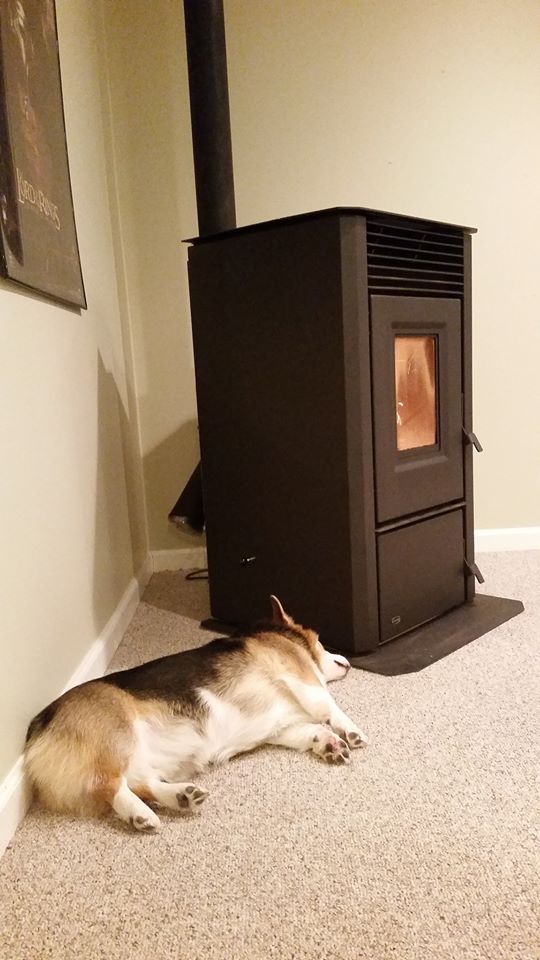
5. The pellet stove we just had installed late this summer. Though it’s not quite a wood-burning stove—and does require electricity—it has brought much warmth to our home, both literally and metaphorically. Oh, and the dogs love it!

Yoda sleeping near stove

6. Books! And the education I received that enables me to appreciate them

7. The tiny alien swimming around in my belly.

8. The medical care—even when annoying—to look after said alien.

9. The outdoors. Sometimes just a few minutes outdoors provides just the recharge I need after a busy, stressful, people-filled day.

10. Speaking of people, people! Though I prefer alone time, I appreciate the friends and family in my life who are able to support me on rough days.

11. Family. I was blessed this month with two Thanksgiving dinners and double the time with family.

12. Electricity. As the afternoons grow darker earlier and earlier, I can’t imagine how people kept their spirits up simply by candle light.

13. The stubbornness I inherited from my dad. It has driven me to figure out how to fix things on my own and given me the perseverance I need to succeed in many tasks.

14. The patience I inherited from my mother. Though it doesn’t always manifest, it serves me well when I most need it.

15. Cheese. No, seriously. As an acceptable food for my current diet, it has saved me numerous times while providing needed protein and calcium.

16. The free market. It’s amazing to me that the free market is able to deliver goods right to my door in a matter of days, for a relatively affordable price.

17. The mountains. Every day, driving to work, I drive past a view of the mountains in the distance. When the sun is out, the whole sky lights up in that morning glow, making the day seem magical and full of potential. It’s times like that I realize how truly lucky I am to be alive.

18. Sunrises. Some mornings, I time it just right so that I’m letting the dogs out just as the sun is coming up from behind the bare trees. Though I love the leaves in the summertime, it is only the bare branches that afford me a view of the sunrise from my yard.

Nature's painting. The perfect way to start the day.

Nature’s painting. The perfect way to start the day.

19. The TARDIS cake a good friend made me for my birthday.

TARDIS cake

20. With all the holiday get-togethers, I’m realizing that the thing uniting us is the stories we tell. Fiction or nonfiction, stories hold more truth than much else in this world.

21. Dreams.

22. My car. Yes, I badmouth my Chevy sometimes, but it gets me from place to place (on most days without any problems), and I am grateful for that.

23. A hot shower. Sometimes, after a hot shower, I feel so clean and refreshed that I wonder what in the world it was like to go without plumbing or indoor heating back in the day.

24. Blood memory. I truly believe some memories are inherent in our blood. I find comfort in making Grandma’s meatballs without a recipe, as if I am channeling her talents. It’s a comfort knowing how connected we are.

25. My job. Like my car, my job can sometimes be easy to complain about, but I am grateful to be able to talk about writing and reading all day—and still bring home a paycheck—all while inspiring future generations.

26. Nine Lives. Okay, let me explain this one. You know the saying that cats have nine lives? I think people have many lives, too, and they come in stages. I think of all the memories from grade school and high school and then college and various jobs following. Sometimes it’s hard to believe that all those lives, all those hobbies, all those priorities (that have changed so much since then) were all me. But those lives all make up part of me and add to the wisdom of who I have become. I am grateful for the ability to change and not grow stale.

27. The refrigerator. Sometimes, standing at the refrigerator door and wondering what the heck I feel like eating makes me feel a little ashamed. But I appreciate all the choices I have afforded to me by technology and modern conveniences so that it’s never a question of whether to eat—only what.

28. Living somewhere sane on Black Friday. Don’t get me wrong: I’m not one of those people who camps out for hours before a big sale. I go out after the crazies. But even an 8 a.m. shopping trip can get nutty on Black Friday. I’m glad I live somewhere now that allows me to get away from all the neurotic, crazy people so that a shopping trip even on the busiest day of the year isn’t so bad after all.

29. Like books, I appreciate the ability of a movie to take me out of my life for a while. We look at characters and situations from film and literature as inspiration.

30. Ideas. As long as people are saying “I have an idea,” there is always hope.