Val Muller

The Electronic Wordsmith

Browsing Posts published by Val

Today I’m featuring author Jaidis Shaw, author of recently-released Destiny Awaits (Juniper Grove Chronicles #1). She has agreed to subject not only herself to an interview, but one of her characters as well. Be sure to enter the giveaway at the end of the interview for a chance to win a copy of her ebook!

Without giving too much away, can you tell us a bit about your book?
After the death of her parents, Alayna Scott packs up and moves to Juniper Grove in hopes of starting over. But instead, she unknowingly catches the eye of a local vampire who selects her as his next meal. Through a series of events, Alayna is brought into a world that she never knew existed and struggles to not only survive but against what she has become.

Synopsis: Twenty-year-old Alayna Scott receives visions around water, but even her foresight couldn’t prepare her for the tragic accident that claimed the lives of her parents. With everything she loves gone, Alayna packs up and moves to the small town of Juniper Grove in hopes of starting over. Jayden McKnight can’t explain the attraction that he feels whenever Alayna is near, but he does know that he will do whatever it takes to win her heart. When a vampire selects Alayna as his next victim, Jayden will stop at nothing to ensure her safety – even if that means bringing Alayna into a world that she never knew existed. Love blossoms, challenges are made and Alayna will find herself fighting not only to survive, but to understand what she has become.

If your book were a movie, what rating would you give it (PG, R, etc.)?
If my book were made into a movie, I would like to think that the rating would be PG – 13 since the book is geared towards a YA audience.

Questions with Alayna

I understand that water holds a special power for you. Tell us about it.
For those of you who I am just meeting for the first time, the power that my lovely host speaks of is the ability to see visions in water. Before I moved to Juniper Grove, I did everything I could to keep my visions a secret so that people wouldn’t consider me a freak. That all changed after I moved and I found that I needed the visions to survive. I am becoming more comfortable with the visions and myself with each passing day.

Why did you decide to pack up everything and move to Juniper Grove?
My move came out of necessity and desperation. It was hard enough to accept the death of my parents and there was a small chance that I could have stayed and made it work but I just couldn’t do it. Everyone treated me differently after the accident and no matter where I went or what I did; someone would always say how sorry they were or how terrible it was. Have you ever tried to move on after a tragic loss and even though people try to be sympathetic, you just wish they would act like it never happened at all? That’s how I felt. I was struggling to keep things together and I just needed to get away and go some place where nobody knew about the accident.

I’m sorry to hear about your recent attack. What can you tell us about it?
It certainly came as a shock, that’s for sure. I was just outside, minding my own business, when a man came out of nowhere. Of course later I found out that what I thought was a man was in actuality a vampire who thought it would be funny to sink his teeth into my flesh. For better or worse, that attack has changed my life and there is no way that I can go back.

Who is Jayden, and how would you characterize your relationship with him?
Jayden is amazing! *Smiles* He started out as my neighbor when I first moved to Juniper Grove and he helped me get my new house cleaned up. I knew when I first met him that I liked him but I was hesitant to let anyone close to me. But when he risked everything to save me I knew that I needed him in my life. Some people may think that I rushed into a relationship with him but we make each other happy and that’s all that matters.

I’m thinking about relocating. Would you recommend I move to Juniper Grove?
Vampires aside, Juniper Grove is an amazing place to live and there are so many wonderful people and businesses here. There is an amazing bakery in town that has re-opened and sells these homemade pepperoni rolls stuffed with cheese. They are so delicious and I could eat them every day! I’m so glad that I chose to move here and if you are ever in town, be sure to stop by and say hello.

Author Bio: Jaidis Shaw currently resides in a small town located in South Carolina with her husband and beautiful daughter. With a passion for reading, Jaidis can always be found surrounded by books and dreaming of new stories. She enjoys challenging herself by writing in different genres and currently has several projects in the works. When not reading or writing, Jaidis fills the position of Book Tour Coordinator for Nurture Your Books™, maintains the Juniper Grove blog and loves encouraging her daughter to let her imagination run wild.

Links:


continue reading…

The One and Only Ivan by Katherine Applegate

The story is told through the eyes of a silverback gorilla named Ivan who lives in a run-down “domain” as part of an exhibit at The Exit 8 Big Top Mall and Video Arcade with a handful of other neglected animals. Ivan tries to dwell on the positive element of his life, taking an especial interest in artwork. His “drawings” are sold to tourists but don’t raise enough money for the manager to give the animals proper living conditions. As the story progresses, Ivan makes a promise to a dying elephant to save the attraction’s newest resident from spending a miserable life there, and it’s up to Ivan to figure out how to use his artwork to this end.

The book is targeted toward ages 8 – 12. The language is highly-accessible—I read it within a day. (Ivan notes that gorillas, unlike humans, are efficient in their communications). Because of the nature of the first-person point of view, the true plot of the story doesn’t emerge until about halfway through, though there is plenty of foreshadowing as elements of the main conflict merge through Ivan’s musings and recollections in sometimes startling and frightening ways. His musings are sometimes humorous. For example, he notes, “I draw the things in my cage, simple items that fill my days: an apple core, a banana peel, a candy wrapper. (I often eat my subjects before I draw them.)” Sometimes, his musings are jarring, such as his recollection of the violent murder of his parents. Sometimes, his musings are inspiring. As an aspiring artist bound by a gorilla’s mind, he has trouble creating artwork that is abstract—he cannot envision what is not directly in front of him.

The author was inspired to write the tale after reading about a gorilla named Ivan, who lived for 27 years in a tiny cage in a local shopping mall. After public outcry, the real Ivan was moved to an actual zoo, where he became somewhat of a celebrity.

At times, Ivan’s voice is chilling. Just as Ivan is physically trapped in a cage, there is a deeper part of Ivan trapped within the mind of a gorilla—something human, an artist that wants to envision potential beyond reality—but struggle within the limits of a simian brain.

As with any narrative, the first-person point of view presents both benefits and liabilities. Because of the gorilla’s limited perspective, there are no extensive descriptive passages; but his point of view is also what gives the book its charm. For writers, it’s a quick read, and I would recommend it as a study in point of view. For kids, I would recommend it for animal lovers, artists, dreamers, and anyone who believes in the possibility of pushing oneself to help build a better world.

I just finished the book The One and Only Ivan by Katherine Applegate.

A coworker loaned me this book because of its use of first-person point of view from an animal’s perspective. She thought it might be an interesting contrast to my third-person limited use of animal point of view in Corgi Capers. I enjoyed the story and thought I’d thought I’d use it to kick off my goal of reviewing one book per week. This is a lofty goal, and I’m not sure I can continue it when school starts again in August, but until then I’ll post a review every Monday. For now I have a huge stack of “to be read” books (as well as a virtual stack on my Kindle); however, if you are interested in having me review your book, please contact me via email.

When we were younger, my sister and I bought my dad a mug for Father’s Day. It read Dad: Nature’s Money Tree. And while it’s true that my dad (sometimes) graciously acquiesced to our constant request for money or toys, now that I’ve grown up, I’ve found that my father is worth more than the mug claims. My dad is invaluable to me as a writer and as a support in a number of ways.

Writer’s Goldmine

When I described my father to one of my college professors, my professor told me that Dad was “a writer’s goldmine.” The experiences I’d had with my dad, he said, could provide a lifetime’s worth of writing material. And this is to say nothing of the experiences I’ve had with Dad since then.

Today being my dad’s birthday—though I wouldn’t dare mention his age, and especially since he was very kind to me on my big 3-0—I thought I’d write him a tribute to all the experience I’ve taken from him thus far in life.

The Yes-No Game

Writers are seldom “normal” personalities. They all have quirks. One of my college professors reminded us that most happy people don’t write—they’re too busy being happy and doing happy things. Indeed, writing is often more of an obsession. Poe was obsessed and paranoid. So was Hawthorne. Writing for many is a way of making sense of their world. As Asimov said, “I write for the same reason I breathe: because if I didn’t, I would die.” Writing has always been inside me, and I’ve wanted to write since I could first hold a pencil.

I didn’t realize it at the time, but my dad’s quirky characteristics helped develop the sense of creativity that has allowed me to express myself through words. My dad trained me never to be content, never to sit passively and let the world go by. I was always to be alert, questioning things, thinking of possibilities.

When I was only first learning language, he played a game called The Yes-No Game. You might have seen Bugs Bunny tormenting his rivals with it. The game might start with a question or a bit of conversation that ended with me saying “Yes.” In response, my dad would say “No.” We would go back and forth like that, YES-NO-YES-NO until I became nearly enraged and screamed the answer with all my might, not even sure why I was so adamantly arguing my point. And then my dad would flip things on me. He would say “Yes,” and I would—just as adamantly as before—shout “No!” Dad could substitute anything for “yes” or “no.” It could be RED-GREEN, COLD-HOT. It didn’t matter—as long as the two words were opposites.

Let It Be

Then there was the Crawling Baby. I had this little plastic baby toy that crawled when you pushed a button. My dad would spend what seemed (to a young girl) like hours building a huge castle—taller than me—out of wooden blocks. As he was building, he would casually mention how fun it was going to be for him to knock down the blocks. “When I’m finished,” he told me, “I’m going to have so much fun knocking down this castle.”
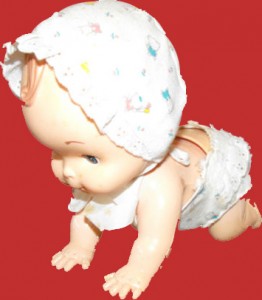
I sat there watching him build, working myself up to the point where I had to be the one to knock down the castle or I’d absolutely burst. When he finished his castle, he sat on the couch and held me on his lap. I was so infatuated with looking at the castle and imagining knocking it over that I would never notice the baby toy in his other hand. He pushed the button and set the baby on the floor. It took me a moment to figure out what was going on—to see that the baby’s trajectory put it on the path to knocking over the castle.

“Let it be,” my dad would say calmly as we watched the toy in its excruciatingly slow crawl toward the castle, its motorized whirr taunting me. Dad would hold me in his arms until I was fit to burst at the fact that the toy—not me—would have the honor of knocking over my dad’s castle. And all this time, my sister was off somewhere, calmly enjoying herself while I suffered in torment. My mother was probably in the kitchen shaking her head because she could hear us winding up for a brawl and knew that she would be the one to have to calm me down when it was all over.

At the last minute, of course, Dad would usually let me break free from his arms and race the baby to the castle. There was nothing like the joy of knocking it over, and by that time I was so upset at the possibility of being restricted that knocking over the castle was accompanied by ear-piercing screams of frustration and victory.

Even then, Dad had sewn the seed of determination in my young mind. And to this day, when I get a goal in mind, I won’t give up on it—and failure only makes me want it more. To this day, I cannot “let it be.” I cannot be content knowing that something out there needs to be done or accomplished. Knowing that there is a slow-moving crawling force making its way toward something that could be mine.  Knowing that someone is holding me back from achieving what I want.

The Knudge
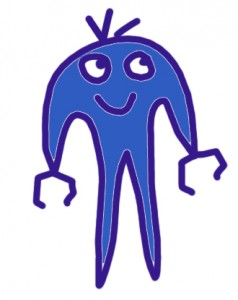
The Knudge

This illustration is The Knudge. My dad has been drawing him since before I was born. Notice the pincers on its hands, its most telling trait. That’s because it likes to torment others, albeit in a good-natured way (as its smile suggests). Just like my dad.

Case in point.

At night, my mother would spend careful minutes creating a halcyon mood before bed. My tiny sister and I would be tucked under the covers, our heartbeats low, ready for the sandman. But instead we got The Knudge.

Dad did everything in his power—in the most friendly way possible—to get our blood pressures soaring again and ruddy our sleepy cheeks. Sometimes he would pick us up and put us in each others’ beds. This would cause a fit of the giggles as we raced down the hallway, shrieking while we hurried to our own beds before he scooped us up and again deposited us in the wrong room. And always, there would be Mom, her disapproving scowl melting to kindhearted amusement at The Knudge’s efficiency in undoing her careful motherly work.

When my sister and I were older, The Knudge’s physical torments turned psychological, causing my sister to drop off the list of prey. Tucking her in, he’d turn one of my sister’s collectibles so that it faced backwards. “I bet you won’t be able to fall asleep with your frog statue facing backwards,” he said tauntingly.

My sister only shrugged, flipped over in bed, and closed her eyes. The Knudge, an entity that feeds on adrenaline and paranoia and laughter and aggravation, had met the only thing that could defeat it: cold indifference. It thrived on psychological torment and an opponent’s drive for revenge.

I was its perfect meal.

My dad came into my room. Now I’m not necessarily a neat person, and I’m nowhere near obsessive-compulsive. But I’m stubborn as a mule, and if I get an idea stuck in my head, there’s no talking me out of it.

“Your sister didn’t care,” Dad said. “Let’s see if your mind is as disciplined as your sister’s.”

Even without knowing what was going to happen, my blood started to boil. I had nightmarish visions of the crawling baby knocking over the blocks. Echoes of the Yes-No game. I was on full alert.

I remember it as if it was last night. It was a bright yellow, plastic lock I’d gotten in a box of cereal. It had a sticker of Tony the Tiger on the lock, and it glowed in the dark. When you turned Tony the Tiger sideways, the lock would open. When he was upright, it would stay locked. The lock was “protecting” a small safe I had (full of pennies) on my bookshelf. Right before bed, Dad tucked me in, but before he turned out the light, he said, “Just one more thing.” He walked to my bookshelf and turned the lock sideways. He looked at me and smiled and said, “Let it be.”

I let out a whimper. I was so warm and comfy in bed. He turned out the light.

“Oh,” he said. “You can see it glowing in the dark; you can tell it’s sideways. It’s okay,” he said. “I’ll bet Tony the Tiger likes sleeping on his side.”

He said goodnight and went out into the hall. I did not hear his footsteps disappear down the stairs. No. He was waiting.

I tried to push the image of the lock out of my mind, but it was just like the crawling baby. It was just like the Yes-No game. I was game.

I let out a scream and flung off my covers. I threw on the light and dashed to the shelf, fixing the lock. As I crawled back into bed, I heard uncontrollable laughter from down the hall. It was The Knudge, rejoicing in his victory.

“Mom!” I screamed, and my mother would race up the stairs and have to work her motherly charms to calm me enough to fall back to sleep. And then I’d hear her gently scolding her husband as they walked downstairs, my father still stifling his laughter.

The Wise Man

Now I could fill page after page with anecdotes about my dad. Like all the times he dumped a bucket of water on me from the third-floor bathroom as I was calmly eating at the summer picnic table. Like the time I had stayed bone-dry during a white-water rafting trip and he let all the other rafters know, causing a deluge of water from their buckets, all directed at me. Like the time he told me the moon has magical powers, or that trolls would turn me to stone if I stayed away past midnight. But I’m not sure all these stories could fit inside just one Internet. So I’ll stop here. But I will say this:

My dad has an expression he always used. “It’s not that I’m smarter than you—it’s just that I’ve been around longer to make more mistakes.” I didn’t believe him at first, but now I do. My dad recognized my quirky personality at an early age. My mother is one of those “happy” people my professor told me about, too busy being happy to worry about obsessive things like writing. So is my sister. Only my dad seemed—even if subconsciously—to see my true personality emerging. And his quirks and games helped me. I’m a compulsive worrier. If I don’t have something to worry about, I worry about why I have nothing to worry about. If I’m not overly busy with a list of tasks I couldn’t possibly accomplish, I feel unsure of myself. Growing up, my dad and his kind-hearted torment helped me with my obsessiveness.

Worrying about the Yes-No game, worrying about fighting a plastic crawling baby, worrying about whether I would turn into stone if I didn’t fall asleep fast enough… as crazy as that may sound, these things actually helped me. There was a time after the busy days of college where I lost myself. I was teaching, but I was sick in a way that medicine or sleep couldn’t help. I didn’t have a particular plan or goal or direction, and I didn’t realize what was wrong. But I know now.

While I was trying to figure out my life, I was sitting on the sideline. All around me were little crawling babies threatening to knock over castles that should be mine. And for a time, I wasn’t doing a thing about it. All over there were trolls trying to turn children into stone, picnic tables waiting for a bucket of water, moonlight waiting for a spinner of tales to harness its magical power. And I was just sitting on the sidelines, letting it all pass me by.

And one day, it came back to me. All the quirks, all the adrenaline, all the desire to improve my situation. The world had told me “No,” but I wasn’t going to have it. I saw in the distance an impossible task, a huge castle looming in the distance: I wanted to be a writer.  And there was the world, a slow-moving baby approaching the castle and whispering “no” to me. “No, no, no. It can’t be done.”

I picked up a pen. My blood started to boil, and it made me smile. The world whispered “no” once again. But I just shook my head. And shouted “yes.”

Happy Birthday, Dad!

Leesburg Patch

No comments

Thanks to Leah at the Leesburg Patch for featuring me!


You can check out the story here:
http://leesburg.patch.com/articles/local-author-inspired-by-pet-corgis

I wanted to take a moment to thank The School of Education at The College of William and Mary for posting an update about Corgi Capers on their site.

I greatly enjoyed my time at William and Mary, both in academics and atmosphere. One of the things I miss after having moved away is walking around the beautiful campus, which spills into Colonial Williamsburg, in the evenings.

You can view the post here: http://education.wm.edu/announcements/inthenews/alumni/muller-v.php

In case you missed them, I’ve been hopping around the Internet doing guest blog spots on various sites in promotion of my sci-fi Romance story For Whom My Heart Beats Eternal. You can check out the posts at the links below. Please note that since they promote Romance works, most of the sites below are designed for adults only:

D. Renee Bagby Presents First Chapters (12 April 2012)
Read the first section of For Whom My Heart Beats Eternal.

Suzzana C. Ryan’s Blog (22 March 2012)
Check out my interview! Does my love of Ray Bradbury’s work have anything to do with the fact that my story contains time travel and artificial intelligence?

Remmy Duchene’s Blog (20 March 2012)
Learn more about my inspiration to write sci-fi/time travel.

Don’t forget, you can check out my novella at Amazon.com and Omnilit.com.

Thanks for stopping by 🙂


I’ve just learned that Chicken Soup for the Soul: Messages from Heaven, a book for which I wrote two nonfiction stories, is officially a bestseller. This comes as no surprise. I have written pieces for Chicken Soup books before, so I’ve gotten to read plenty of books in the series. While they all feature heartwarming tales, there was just something about Messages from Heaven that made it stand out, taking its place as my favorite of all the Chicken Soup books I’ve read.

Messages from Heaven, a Bestseller

The book features true stories of experiences people have had with messages from beyond this world. My “contact” with the world beyond has always been through dreams. But when I read some of the stories in the anthology, I was surprised to learn that others have had similar experiences to mine, even though not everyone “saw” their experiences through dreams.

For example, one theme in my dreams has been that I am never “allowed” to fully see what the world beyond looks like. It is always shrouded in shadow, with just enough light—almost like a spotlight on a stage—for me to see just enough. Just enough to reveal a location or a person, but never more than that. In the dream in which I met my grandfather, a man who died before I was born, the world he stood in was intentionally shadowed. In other stories in the Chicken Soup book, young children were given a glimpse of what lies beyond, but they refused to disclose any details to the world. It seems there’s a common theme about not being allowed or able to disclose many details about the world beyond. Even the Bible makes us aware of this—those who have seen glimpses of what lies beyond are not allowed or able to communicate details. The fact that my view was shadowed is interesting. As a writer, I certainly would have exploited my experience, disclosing it to as many people as possible with as much description as I could use. It’s as if those who chose to show me a glimpse of the world beyond—namely my grandfather—knew better than I did.

I recommend the book for anyone interested in what lies beyond, to anyone who has fears of leaving this world, or to anyone who has lost a loved one. The book provides rare comfort in this world. I read a chapter or two before bed and was always lulled into a sense of comfort before bed. There is nothing to make life enjoyable like the light of peace and the comfort of hope.

When I was a kid, I hated being told what to do. I loved playing outdoors, but one of the things I absolutely hated was helping my parents with gardening. They were shocked. After all, I loved plants, dirt, worms, sandboxes. What wasn’t there to love about getting dirty and spending time outside? I tried to explain it to them, but as a kid I couldn’t articulate why I didn’t like helping them with their gardens. But now I can.

It was the lack of freedom. When we planted tomatoes they had to be in neat rows, each one identical, each one filled with such-and-such amount of peat moss, manure, topsoil; each one topped with such-and-such amount of grass clippings, mulch… If I didn’t do it exactly right, they’d fuss at me: “That one’s looking a little tilted” or “there’s not enough manure in that hole there.” I disliked helping them with their gardening because I wasn’t allowed to be myself. I was allowed no personal freedom. Not one bit. Wear gloves. Don’t touch anything with your bare hands. Use such-and-such a shovel. The pansies had to alternate purple-white-purple-white with no variation. It was mindless work, robotic work. I was a cog in a machine.

Of course now, all grown up, I love gardening. But that’s because the garden is mine. Mine to grow successfully or mine to fail. My creativity, my decisions. I’ll tell you that there are never neat rows or square gardens or intricate color patterns. Just my personality expressed in plants.

And it’s a good metaphor for the way I live my life. I love freedom. I thrive on it. The best thing you could do is give me a blank sheet of paper and allow my imagination to run wild with it. Maybe I’ll write you a story. Maybe I’ll draw you a comic strip. Maybe I’ll make a better paper airplane. Maybe I’ll use it to start a campfire or a compost heap. The point is, it’s mine to try my hand at, to succeed or fail. And the next time you give me a blank sheet of paper, I’ll draw you something even better.

And that’s the principle that made this country great. The American Dream means there is no caste system: no one is stuck in the place he was born. Just look at Steve Jobs. Citizens are given property rights and freedom to live. And that’s it. There are no intricate rows that must be planted. No measured amounts of manure or peat moss that must be placed around each tomato. Or at least there shouldn’t be.

But the government has been growing year by year—it’s been happening for decades and decades now, and despite Uncle Sam’s good intentions, government’s attempts to help have been slowly forging chains, denying us the freedoms that made this country great. These policies have even been limiting our ability to travel between socio-economic classes. Whether you are liberal, conservative, or independent, the media is not on the side of truth. The media is not on our side. Issues are muddied with bitter oversimplification aimed at inspiring hatred at the opposing party. Truth is hidden in our government’s self-destructive bi-partisan structure. Politicians rarely act in the best interest of all involved but rather follow polls and buy votes with policy—or deny useful policies to make opponents fail. Both parties, and most politicians, are guilty of this falsehood.

For years, my husband and I sat around in frustration, wondering what we could do—two ants on a muddied globe. And now, we’ve taken a small step. My husband has started a new small publishing company called Freedom Forge Press, LLC. Its goal is to advocate freedoms on all fronts, illuminating the truth behind issues in a non-partisan way. We believe the most powerful tool anyone can be given is education and the ability to think critically about each issue. The great thing about America is that despite various beliefs, religions, and philosophies, Americans are free to live as they wish without having the beliefs of others imposed upon them. The government sometimes mistakenly creates legislation and regulation in an effort to help, but actually ends up causing more harm than good. In an ideal world, severe government intervention is not needed. Individual freedom is checked by individual consequences. An auto company would either have to build a better, more efficient car—or else go out of business. A student would have to study hard—or else drop out of school. In my gardening metaphor, my refusal to follow the “rules” of gardening might result in a failed tomato crop. But that one year of failure would teach me a lesson that couldn’t be learned by my parents strictly regulating how many cubic inches of manure I must add per tomato plant.

To help build interest in Freedom Forge Press, the company is hosting a giveaway. Sign up to follow FFP on Facebook or Twitter—or even just browse the site—and you’ll be entered to win a gift card to Amazon.com. Check out the contest here: http://www.freedomforgepress.com/2012/03/22/giveaway-contest/ It’s open for a few more days.

In addition, Freedom Forge Press welcomes guest bloggers writing on any topic involving the theme of freedom. Check out the “submissions” page for more information. Also, keep your eyes open. FFP will soon be opening its first fiction/nonfiction anthology on the theme of freedom.

Thanks for stopping by, and I hope you’ll check out Freedom Forge Press.

Bark for Life

No comments

I wanted to mention an event I’ll be participating in this May. It’s called Bark for Life, and it’s part of a fundraiser to raise money to fight cancer. The event takes place in Hanover, PA, on May 12th, and it features a one-mile dog walk with lots of doggie-themed door prizes and gifts. There will also be dog-themed vendors (including a certain author autographing copies of Corgi Capers!). The best part is: you can bring your dog(s)! If you’re in the area, please stop by and help raise money for a good cause.

MORE INFO:

May 12, 2012 at West Manheim Twp. Recreation Park

Registration begins at 8:30 a.m./Opening Ceremonies at 9:30 a.m.

This is a non-competitive walk event for dogs and their owners to raise funds and awareness of the American Cancer Society’s fight against cancer.  By supporting Bark For Life you honor our canine caregivers, help save lives and help us move closer to a world with less cancer and more birthdays!

Event includes a 1-mile walk, prizes for Tallest & Shortest Dog, Best Dressed Dog, and Best Trick, incentives for $100, $200, & $300 fundraisers, 50/50 drawing, dog-related activities, demonstrations, artists, and authors, Relay For Life booths, and giveaways.

Event Details:

–          Registration prior to the event $10 for the 1st dog, $5 for each additional dog

–          Registration day of the event $15 for the 1st dog, $10 for each additional dog

–          Bandana for each registered canine

–          Door Prize ticket for the owner of each registered canine

–          1 mile walk on a designated trail through the woods

–          Prizes awarded for Tallest & Shortest dogs (measured from ground to top of dogs shoulder when standing on all 4 legs), Best Dressed dog, Best Trick

–          Incentives will be awarded for $100, $200, and $300 fundraisers

–          50/50 drawing

–          Dog-related activities and demonstrations

So bring your canine friend and have a paws-itively great time!

Details: visit the Bark for Life site,  or e-mail.

What it is:  The American Cancer Society’s Bark For Life is a fundraising event honoring the lifelong contribution of our canine caregivers.  It is a non-competitive walk event for dogs and their owners to raise funds and awareness of the American Cancer Society’s fight against cancer.  The heart of Bark For Life is the relationship between cancer survivors and their canine companions.    They are always there to share unconditional love, joy, and compassion.  This provides us with an opportunity to honor their caregiving qualities, and to walk side by side with them to help us move closer to our ultimate goal of creating a world with less cancer and more birthdays.