Val Muller

The Electronic Wordsmith

Welcome to The Spot Writers. This month’s prompt is to write a story where water plays a role. It can be a lake, a river, the sea; rain or just some water to drink.

This week’s contribution comes from Cathy MacKenzie. Cathy’s novel, WOLVES DON’T KNOCK, a psychological drama, is available from her locally or on Amazon. MISTER WOLFE, the sequel, coming soon, as well as MY BROTHER, THE WOLF, the last of the series.

***

“It’s in the Eyes”

by Cathy MacKenzie

Chet stops by the clump of trees along the bank of Mira Lake, which flows into the Atlantic Ocean. He clearly sees the object that rhythmically sways as if in tune to music.

Without hesitation, he jumps in. The water is deep, and as he nears, the colours become brighter and bolder. The female is mired in brambles. He tries to disentangle her, but it’s impossible—and too late. Her limbs flail, hampering his progress.

Her bulging eyes glisten and sparkle. Did she cry before the water swallowed the tears whole? At the instant life departed from her eyes, did time stop for her? Was it like a wave high in the sky before it plummeted upon an unsuspecting swimmer? Did she have any inkling what was to befall her?

Will the woman’s motions eventually stop, or will she flounder forever until creatures scavenge the flesh?

Too many unanswered questions.

He swims to the surface, flapping his arms and kicking his legs, and when he explodes into sunlight, he faces the sky, inhales a great breath, and howls.

*

He wakes when the sun rises. He slips from bed and stands by the bedroom window. Shades of flaming red splash across the horizon, reminding him of Jennifer’s hair splaying underwater.

And the eyes!

Isn’t it always in the eyes? The eyes of Jennifer. The eyes of Isabel. The eyes of Barb.

Jennifer stared—dead yet alive—her motions performing a version of a weird dance. Alive yet dead.

Isabel was the easiest. Her eyes remained open for eight minutes—he’d counted—but closed when she succumbed, disappearing forever into the ocean’s depths. No graceful dance—not even an odd dance—for her.

Barb? Her eyes were amber. Sneaky like a cat. He’d never forget those eyes. And her name? Had she been born a Barbara? He once knew a Cindy whose legal name hadn’t been Cynthia.

Cindy. Another one.

And other women. Had to have been more.

He combs his fingers through his hair, wishing he can remember. He yawns and rubs his eyes. He hardly slept. The same nightmares every night. The women, all dancing under water with bold, wide eyes…

He didn’t do anything; he’s positive he didn’t. Yet—

Those time lapses. Blackouts. Missing blocks of time.

He hates how he occasionally wakes, day or night, not remembering what had transpired the previous few hours.

He yawns again. No matter. Not as if he can do anything about it now. The past is the past. Where it must remain.

He returns to bed, dreading the clear-as-day night dream that will wash over him again.

***

The Spot Writers—Our Members:

Val Muller: https://valmuller.com/blog/

Catherine A. MacKenzie: https://writingwicket.wordpress.com/wicker-chitter/

Phil Yeats: https://alankemisterauthor.wordpress.com

Chiara De Giorgi: https://chiaradegiorgi.blogspot.ca/


Welcome to the Spot Writers. This month’s prompt is to write a story where water plays a role. It can be a lake, a river, the sea, rain, or just some water to drink. It comes to us from Val Muller, author of the Corgi Capers mystery series.

Metamorphosis

By Val Muller

I still see her in my truck bed,
As she looked that dawn,
How she turned over in her sleep,
tucked her leg out of the blanket
and kicked through the fabric
almost like she was swimming.

I shake my head at myself
Picking up a hitchhiker
Like I don’t know any better,

Driving her to the diner in the middle of the night,
Paying for her fish n chips
Because when they brought the check,
She acted like she never heard of a dollar.
She gave me her seashell bracelet
and asked if I would drive her to the coast.
Her lips pouted like a siren’s.
I lied and said
I was headed that way myself,
Hundreds of miles to the west,
That there was plenty of room in the truck
Whose cab barely held me.

Her hair blew out the open window like it was tossed and turned in the tides,
And I drove through fields of corn that swayed as if under an ocean current.
Hours passed, eternities passed, and her scent filled my truck with the fragrance
Of all that was missing in my lonely, landlocked life.

Hundreds of miles washed over us, and I had to sIeep.
All my money gone to gas and food,
She didn’t blink when I said we would rough it.
I offered her the cab, but she insisted on the truck bed,
Said the stars speckled with clouds seemed like seafoam to her.
She hummed a song that flowed in through my open windows
And lulled me to sleep like the soft crash of waves.

When we reached the coast, she seemed brighter somehow,
stronger, shimmery, secret in the sunrise,
and although this farm town boy had seen the ocean only on screens,
I could not break my eyes from her as we walked the sand.
She grabbed my hand only once, the smoothest touch I had ever felt.
It was like, I later learned, a smoothed sea-glass,
made sleek with hundreds of years in the surf.
Her lips, the one time she kissed me,
Tasted of salty air.

She stepped in the water and turned to me once,
smiled, and let the waves lap her up.
She disappeared in a rush of foam.

I ran out to her, not even thinking,
this is the first time I’ve felt the ocean.
Instead, I searched with eyes and arms and hands,
Trying to find that smooth skin,
That sleek hair.

My eyes glimpsed only a glitter
that spoke of seashells’ iridescence
And of the mystery of saltwater—
A green glow of a fin.

Years later, I sit on the beach each sunrise,
Rain or shine, summer or chill,
Hoping for just a glimpse
Of she who transformed me,
Who picked me up on the shoulder of my life
And brought me here to the coast,
Where anything seems possible,
Where I wait for a glimpse of magic iridescence
In the place where
The sea air tastes
Like her.


The Spot Writers—Our Members:

Val Muller: https://valmuller.com/blog/

Catherine A. MacKenzie: https://writingwicket.wordpress.com/wicker-chitter/

Phil Yeats: https://alankemisterauthor.wordpress.com

Chiara De Giorgi: https://chiaradegiorgi.blogspot.ca/

This is not my first review of an Anderson book—I am obviously a fan. I’d say this is a good early YA/advanced middle grade reader. I had purchased it back when I read Chains, also about the early American time period, then shelved it for other things. I saw it while cleaning off a shelf to prepare for pandemic work-from-home and realized how timely the novel is.

It takes place during the summer of 1793 in Philadelphia. The protagonist, a young woman named Mattie, helps run the family coffee shop. She resents her family’s limited vision for the business, and she also resents her mother’s attempts to arrange a practical marriage for her.

Soon, that all becomes moot, as yellow fever breaks out. It’s clear the people in 1793 did not fully understand yellow fever (a quick Google search told me it wasn’t understood to be carried by mosquitoes until over 100 years later). The people did understand that the frost would kill the fever, and it becomes everyone’s goal to survive until the second hard frost.

Mattie is caught up in the fever-related paranoia that has become all too familiar to us recently with COVID. Besides a lack of understanding about how to treat the disease (some doctors were still bleeding people, making their recovery much more difficult), there are other similarities. In Philadelphia, food shortages became a common problem for survivors. Worse for Mattie, with so many people fleeing to the country and/or dying from yellow fever, break-ins became common.

I admire Mattie for being a “strong woman,” though I in some ways resent that term. All women are strong. But for so long, women in stories and life were not portrayed that way. Mattie goes against norms and perceptions. She is realistic in that she does need help from time to time, but she is not helpless. I especially admire her actions when she comes across a young orphan and has sympathy, unlike most of the adults she encounters.

This is a fast read—very plot-based—that I am putting on my daughter’s bookshelf for when she is just a bit older. My next read by Anderson will be Forge, the sequel to Chains.

At the beginning of July, when I heard that conditions would be ideal to view the recently-discovered Neowise comet, I smiled inside. I have a bad track record of viewing cosmic events, and this sounded like my chance.

When I was very small, my parents took me to see Hailey’s comet. I remember we drove somewhere cold—a school with a hill. It was dark. My dad painstakingly set up the telescope. I remember my dad telling me to look through, him telling me not to bump the telescope. I don’t really remember seeing anything in the telescope—I may have been too young—but I do remember the smell of the telescope and the taste of the hot chocolate we had from a thermos afterwards. While I can’t say 100% that I consciously saw Hailey’s comet, I can say that it somehow passed through my eyes, and the experience impressed itself upon me. There were other families there on that hill, at what seemed to a tiny kid to be the middle of the night. This comet was something important enough to disrupt ordinary life, and it brought people together.

Many times over the course of my life, I set alarms to try to see one cosmic event or another, but it’s been hard to find people willing to stay up that late/get up in the middle of the night/wake up that early to share the experience. And usually cloud cover foiled my plans, and I spent the next day tired and wondering why I got out of bed in the middle of the night at all. I remember years ago leaving the warmth of my then-townhome, shivering in the driveway while not being able to see whatever it was I was trying to find, and jealously calculating how many neighbors were blissfully sleeping through the cold night.

The only exception had been the somewhat recent solar eclipse, which I was able to see with a bunch of coworkers in the middle of the day. That solar eclipse was really the first “conscious” time I truly experienced a cosmic event without cloud cover and with the company of others. The fact that we were all there together, watching this thing that was larger than all of us, really created a sense of community. It’s a memory that’s burned into my soul, all of us taking a break from work to don our solar glasses and look at the strange patterns of the sun filtering through the trees in little crescents.

The possibility of seeing Neowise called to me, despite being stuck in a pandemic more or less in social isolation. For Neowise, I set my alarm for 4 a.m., which is when the comet was first visible. I couldn’t see it very well with my naked eye. I saw a streak in the sky, but the sunrise was already starting to wash it out. I pointed my camera at what I thought was the comet, and I was amazed at what appeared on the viewfinder. The adrenaline rush told me there would be no falling back to sleep that morning.

Neowise early morning Val Muller

Neowise, captured before sunrise in early July 2020.

Neowise on the horizion Val Muller

Neowise appeared just above the treeline.

Soon, the comet would be visible in the evening, and I used the interim to watch some videos to learn about night photography with my DSLR. The absence of the moon paired with cloudless skies made conditions optimal, and I found ways of playing with exposure and other settings to make up for the lens on my DSLR, which is not meant for night shots.

As I posted and emailed the shots to friends and family, the response was amazing. I received texts late each evening with questions about where and how to find the comet, and I remembered the sense of unity I felt during the solar eclipse, even though the people contacting me were all socially isolating.

Neowise Val Muller

Neowise after sunset on July 17, 2020.

Those whose views were blocked by trees or houses thanked me for posting or sending pictures. People sent me articles with tips about how to best view the comet. Friends texted me late at night with pictures of their own comet quests—friends who would have absolutely no other reason to contact me at that hour. Virtual conversations ensued with friends I hadn’t seen in years over photography tips and camera equipment purchases.

Neowise Val Muller

Neowise on July 18, 2020. My photography skills increased as Neowise faded.

Neowise Val Muller

Neowise on July 18, 2020. One of my favorite shots, with the Big Dipper visible.

I went out each night that the sky was visible to view that comet. The world felt different somehow. Something amazing was happening as I was isolated in my backyard, and I felt like part of something much larger and more significant. The perspective was much needed during a time of global uncertainty.

Neowise Val Muller

Neowise the evening of July 19, 2020. My favorite shot!

Neowise Val Muller

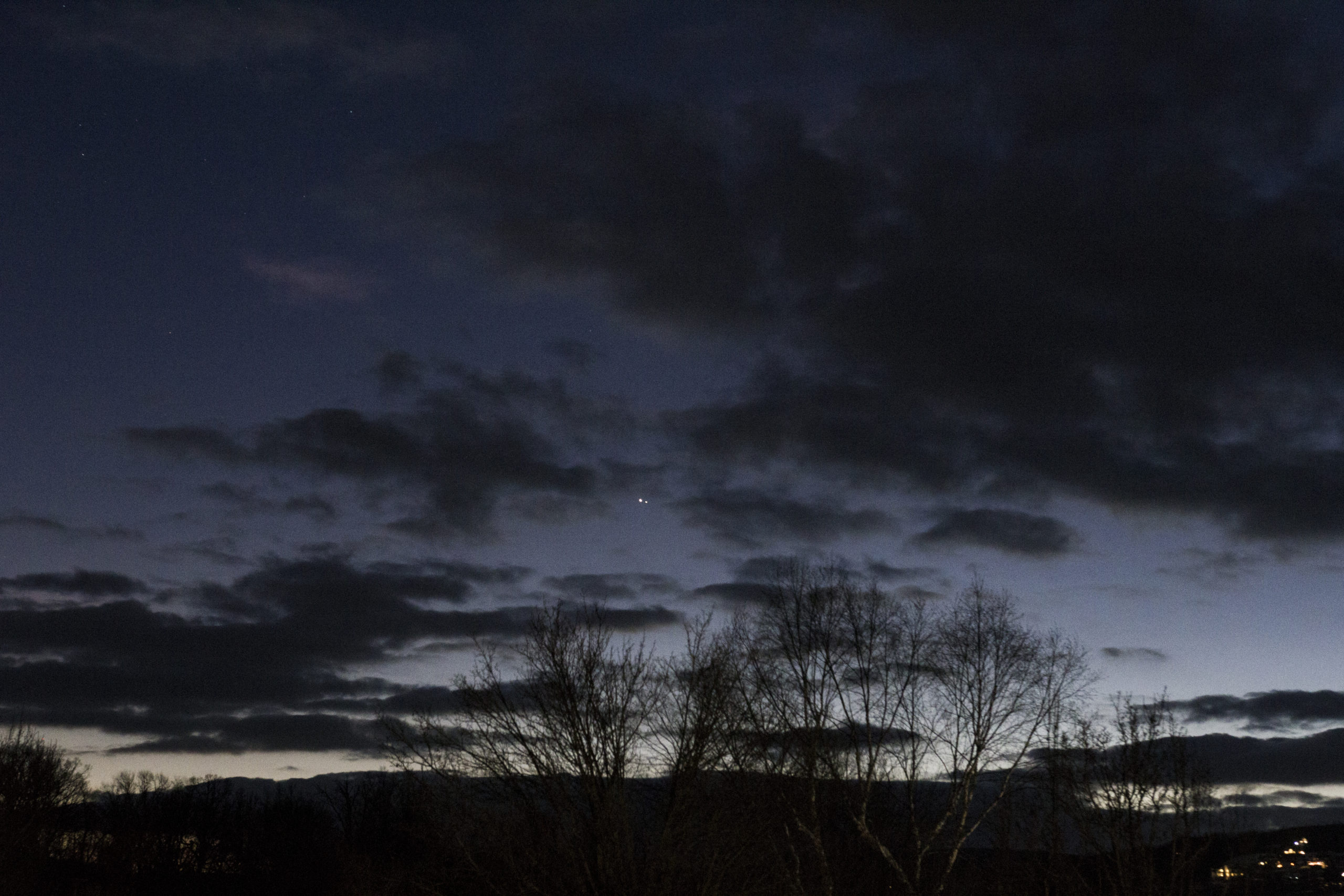
After nights of rain, I resumed pictures on July 25. Neowise’s glory had faded. Can you spot the comet toward the bottom of the picture?

My interest in the comet prompted my husband to take out his dad’s old telescope, which prompted my daughter to take an interest in the stars and moon. It was a needed distraction and a needed nod from the universe that not everything had come to a standstill. There are still amazing things out there, and Neowise was a reminder that positivity spreads. I’m always glad to be a part of helping it to do so.

Neowise Val Muller

By July 26, the comet was barely visible. But my photography skills had improved enough to capture it!

Neowise Val Muller

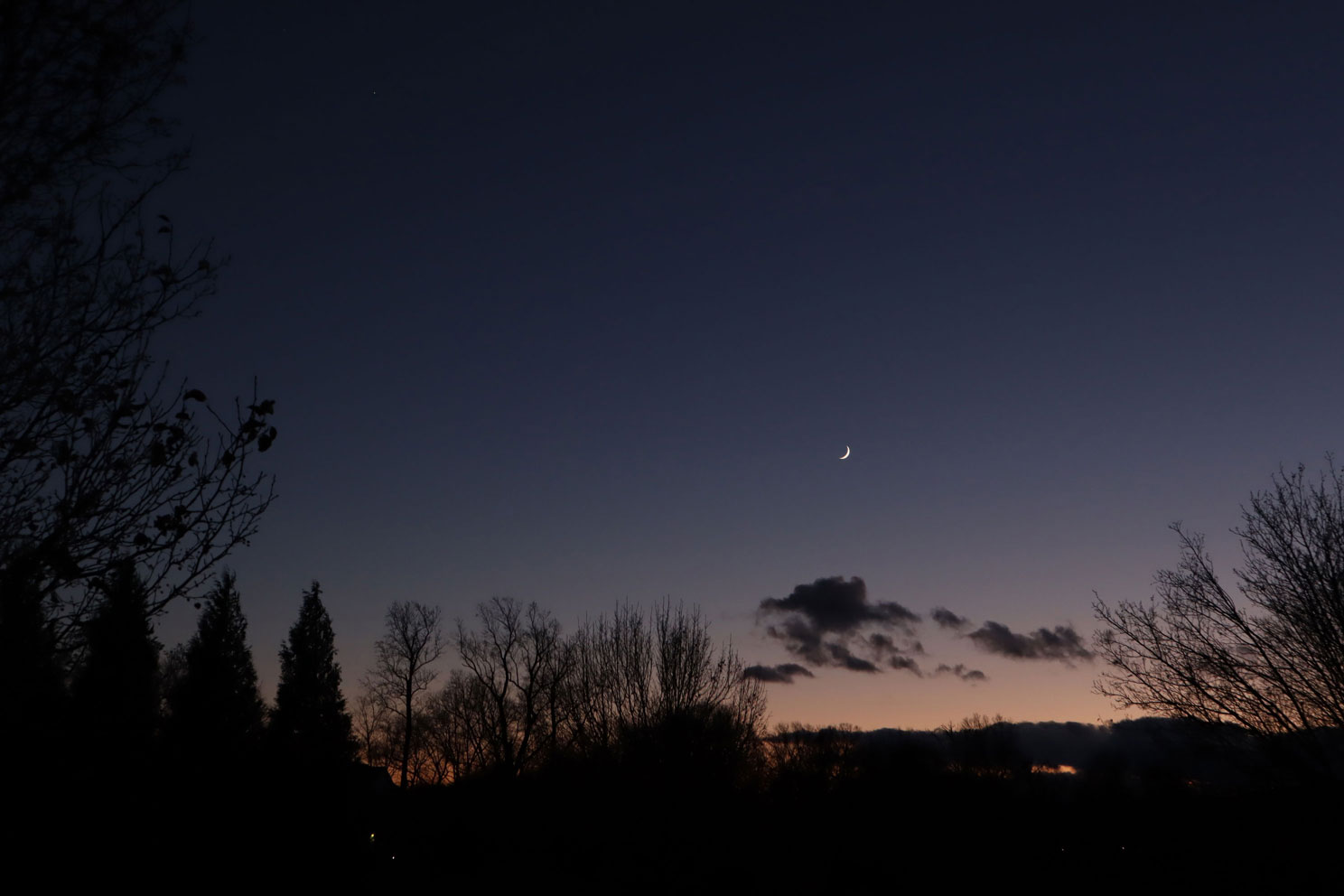
July 27 was the last night that cloud cover did not fully impede the sky. Because of the waxing moon rising earlier, Neowise was also washed out by the moon’s brilliance.

moon val muller

Luckily for me, that meant another object in the sky to practice my photography skills on 🙂

I received my print copy of the Elizabeth River Press annual anthology last week (link here). I’m pleased that my story, “Angel in the Pod,” was included. I like to think of it as a kickoff of my writing comeback. After about four years of not sleeping through the nights, my kids are finally good sleepers, and it has done wonders for my ability to write.

I started with a super rough draft of a novel that I wrote during NANOWRIMO (National Novel Writing Month) last year. I’m writing Corgi Capers 4, and I’ve been working on short stories.

Most recently, I made it to the final rough of the NYCMidnight Short Story Challenge, writing stories I never would have thought to write without the push from the contest. Though I didn’t place in the top ten, making it to the top 40 out of more than 4,700 writers made me remember why I should get back to writing.

For this week’s post, I wanted to highlight the story that appears in the Elizabeth River Press annual. It’s called “Angel in the Pod,” and it’s one of those “big bang” stories. I had the idea while driving to work one day, and I truly did conceive it in an instant. I was watching the clock after dropping my kids at preschool and wondering how many minutes I had between pulling into the parking lot at work and having to go into the building. Was it enough to write something? I thought about all the little things I do all day that take up time, and what I could do with that time if I could save it. And… how would I accomplish this?

Of course the rational answer is to create a doppelganger, a double, someone I could assign the dirty work to. Wouldn’t it be nice if I had a body-double to do my laundry, wash my dishes? And immediately I went into author mode. My mind raced with possibilities for such a story. If we could create a copy of ourselves, would it be “right” to assign it all the boring things so that we could enjoy the best ones? Would we be essentially creating slaves?

But I wanted to write a short story, and the direction that thought was headed was more appropriate for a novel. So I went in a different direction. In the story, a woman receives seeds in exchange for helping someone. Like a modern-day “Jack and the Beanstalk.” My character goes home and plants the seeds.

(Disclaimer: I have been reading about people receiving strange, unsolicited packets of seeds in the mail. My story is fictional. You should not plant seeds if you do not know what they are or where they came from!).

What grows in her garden is a doppelganger, though distinctly non-human in that its lifespan is more similar to a seasonal plant than a human being. Still, with the help that the “pod” affords, the protagonist is able to see her life a little more clearly—forcing her to make decisions her busy life allowed her to ignore.

The story was written and submitted before the pandemic hit, but it ended up being strangely prophetic for me, anyway. With people being forced to stay home and end or change their employment obligations, many have had a chance to re-prioritize, the same way my protagonist was forced to consider her priorities. Some parents have pulled students into homeschool situations. Some people are learning new hobbies or relying on new (or abandoned) skills for their livelihood. The global pandemic is frustrating for most, and we are going through difficult times. I only hope that, like the protagonist in the story, we find clarity at the end of the struggle.

But for now, writing is helping me through it.

Welcome to the Spot Writers. This month’s prompt is to write a story inspired by the phrase “back to normal.” It could be a pandemic-related story about getting back to normal, or one about not getting back to normal, or a story about something else entirely.

The Fairy Lady

By Val Muller

Life cleaning out my parents’ house was an introvert’s dream.

My dad had always been a hoarder, but after mom died, he really lost control. After he passed, I moved into the house. I was between jobs and between boyfriends, and I figured I could live rent-free in my childhood home while making money selling the massive collection my dad had accumulated over the years.

There was barely enough room to push the stuff from my old room into my parents’ bedroom to make room for me to sleep. I managed to cram most of my personal belongings from the apartment into the garage. Eventually, I would clear room for it all in the house.

Each day, I forced myself to fill three large bins of accumulation, sort through them, and trash/sell/keep. I figured, maybe I’d be done sorting through the house in six months or so at that rate—ha!

In the meantime, I returned to the room I grew up in. Besides my bed, I cleared my old student desk, and that’s where I set up my workshop. My dad had found a box of small glass bottles with corks. 84 of them. They were there on my desk, at the bottom of all the other things my dad had saved. They were so new and shiny that I decided to keep them.

That first day I found some miniature thimbles my dad had squirreled away. I thought—they’d be perfect to put in a jar. I added some colored thread around them, and I crocheted some yarn I found into a little mouse. I’ll admit it looked cute—a mousy little seamstress. It reminded me of myself, somehow. A shy little mouse. A little maker.

The next day, I found some rusty hardware—nails, gears, bolts. And a welding kit. I made them into steampunk flowers tiny enough to drop into the jar.

An old video game controller turned into a computer chip tree with wire branches glistening there in the jar.

It was therapeutic, really. My mind stopped racing about the breakup with Robby, and I was pulled into the lull of crafting. I could finally stop replaying my last weeks at the bank in my mind, how I could never make enough sales, was never pushy enough with customers. I put the jars on my bookshelf and looked at them before falling asleep each night.

After that, I made several jars each week. During the days I kept an eye out for little treasures dad had tucked away. Beads, moss, tiny pinecones, trinkets. I felt that I was preserving a little piece of dad and his legacy—while still decluttering. The jars were a shield from the emotional wreck of tossing dad’s stuff, his lifetime of collection. They were a shield from a world of demanding boyfriends and demanding bosses.

The drive to make the jars pushed me to go through the house faster than my goal, and before three months were up, the place was clean. I’d made more money selling his things through local marketplaces than I did at the bank, and I put up an Etsy store for my jars.

Soon all 84 were filled, and many were sold. And the house was clean.

I had no boyfriend and no health insurance. It was coming. I painted each room as a way to procrastinate. I used some of my earnings to purchase new furniture and dishes, to make the home my own.

But after I’d done every improvement I could afford, after I cleared out even the garage, I couldn’t escape reality. I’d run out of things to sell. I’d run out of trinkets to place in jars. I had to go back to work.

I hurried out the door to my new job. Working in the craft store was not the best money, but at the interview they said there was a chance I could lead some classes in the studio. And if nothing else, I would get lots of ideas for future fairy jars.

*

The Spot Writers—Our Members:

Val Muller: https://valmuller.com/blog/

Catherine A. MacKenzie: https://writingwicket.wordpress.com/wicker-chitter/

Phil Yeats: https://alankemisterauthor.wordpress.com

Chiara De Giorgi: https://chiaradegiorgi.blogspot.ca/


I heard about this short novel as it was mentioned briefly in something I was reading about Yann Martel’s Life of Pi, a novel I greatly adore and teach almost every year. When I read the synopsis—a young man who grew up in Nazi Berlin under the gaze of a stuffed Bengal tiger, then finds himself shipwrecked with a jaguar (maybe)—I realized it couldn’t be an accident that Martel drew from the novel. Indeed, on the front cover is a quote from Martel: “I am indebted to Mr. Moacyr Scliar, for the spark of life.”

The novel no doubt sparked some ideas for Martel’s work, and at 99 pages in rather large print, it read quickly (in one sitting for me, which says a lot when I have a four and (almost) two year old at home with me this summer). If someone like Thomas Hardy wrote this book, it would be about 500 pages long, so a lot of plot was compressed into a small space. But it worked. I think Kafka would have enjoyed it.

It’s an odd mix of reality and the absurd. It’s told from a third person perspective. Though we are limited to Max’s perspective on the world, we are never put deeply in it. It reminds me in some ways of the way the story “Gimpel the Fool” (Isaac Bashevis Singer) was told—a straight-forward account of a bizarre situation. It also reminded me of the short story “The Gospel According to Mark” (Jorge Luis Borges) in the way Max becomes an outsider everywhere he lives and is unable to integrate. In all cases, the distanced perspective helps make the absurdity of the situation work. I can’t imagine The Stranger being told in detailed, painstaking sentences as Meursault justifies his behavior.

The novel is for adults—there are some sexual situations (none explicit, though the language is blunt), as well as some anti-Semitism/references to Nazis. It’s an interesting study in how we react to our environment and how the long-term consequences of hatred tend to follow us. And I think that, rather than a characterization of a specific individual, is the purpose of the book.

For me, I read it through the lens of Life of Pi, and I enjoyed things like Max’s uncertainty about whether there really a jaguar on the lifeboat with him, the look at what motivates a person and how people raised in the same area can have differing beliefs.

Welcome to The Spot Writers. This month’s prompt is to write about something “summery.”

Today’s post is written by Phil Yeats. In December, 2019, Phil (using his Alan Kemister pen name) published his most recent novel. Tilting at Windmills, the second in the Barrettsport Mysteries series of soft-boiled police detective stories set in an imaginary Nova Scotia coastal community is available on Amazon.

He’s currently working on a Cli-Fi novel. Information on that project is available on his website.

 Warm Summer Evenings

 Phil Yeats

Years ago, we lived at the end of a cul-de-sac next to a small section of urban forest. On warm summer evenings, bimmers and other fancy sedans would arrive. They’d disgorge teenagers burdened with boomboxes, twofers, and packages of snack food. The drivers would depart, presumably to return their parents’ cars, and reappear on foot with others joining the party in the woods.

From early evening, the raucous music punctuated by occasional noisy outbursts from the participants overwhelmed the usual nighttime forest sounds. Near midnight, the teens, with boomboxes blaring, would emerge from the forest and disperse into suburban city streets.

Screeching owls, and cats expressing differences of opinion, would reassert ownership of their forest. In the morning, scavengers with their grocery store carts would collect the empty beer cans.

We lived in that house for twenty years and observed many teenage gatherings. They consumed prodigious amounts of beer, but we only witnessed one altercation. On that occasion, a sidewalk fight erupted as they left. A neighbour called the cops, and the men in blue defused the situation.

Altercations we didn’t witness presumably occurred in the woods. And potillegal in those less-enlightened daysmust have been consumed.

Our neighbours complained about immoral behaviour and environmental damage. I refused to get involved in discussions of the morality of teenage behaviour but noted they left their trash in a city-maintained garbage bin near the entry path. And the scavengers appreciated the beer cans they left behind.

They were being teens on warm summer evenings, and I envied them as they trooped into the woods. Perhaps if I’d had opportunities for similar teenage social interaction when I was their age, I would have grown into a more sociable adult. Or perhaps not.

More years than I care to remember have passed, and I’m sitting outside another house enjoying another warm summery evening. Our province is recovering from its initial response to the recent coronavirus pandemic. The authorities recently eased lockdown conditions. Limited social gatherings are once again possible. Several members of our writing group organized an in-person meeting, our first in four months.

The risks were minor. Nova Scotia is nearly virus-free, and we’d be outside following the social distancing rules, but I didn’t participate. I fear my reluctance to take part was less about avoiding risk than about avoiding social interactions. Teenage lessons in sociability wouldn’t have altered this lifelong tendency.

The Spot Writers—Our Members:

Val Muller: https://valmuller.com/blog/

Catherine A. MacKenzie: https://writingwicket.wordpress.com/wicker-chitter/

Phil Yeats: https://alankemisterauthor.wordpress.com/

Chiara De Giorgi: https://chiaradegiorgi.blogspot.com/


I can’t remember how old I was when I first read “The Lottery,” but I have been a Shirley Jackson fan since then. I was excited to learn about this short novel, apparently her last published novel, so I snagged a copy. I had no idea what the novel was about; I simply bought it based on author’s name and started reading it with only the jacket flap as a preview to what it is about.

I liked it, but I wished I had liked it more.

The novel is told by an unreliable (or, at least, extremely subjective) narrator named Mary Katherine (aka Merricat). Her voice is so off (not as in an author’s mistake, but as in there is something “off” about her character) that the whole time I was constantly putting together clues to figure out what her real deal is. It’s not too hard to guess the truth, which was a little disappointing. I wanted the mystery to be even more mind-blowing than it was. I don’t think it was a fault of the novel: I think my expectations were unfair. I think that, knowing Jackson, I was expecting a twist…and expecting a twist ruined the experience for me.

Without giving away too much, as there are spoilers if revealing the entire plot: the novel follows Merricat, who lives with two family members—her sister Constance and her uncle, Julian, who is nearing death. Okay, there is Jonas, too, Merricat’s cat. Merricat does weird things: she makes up power words and buries things in the yard—her own form of witchcraft. She also spends lots of time outdoors, doesn’t like to brush her hair, etc. In short, she is what I would have called a “witch” when I was a kid.

We learn that Merricat and Constance’s family was all killed years ago when they consumed poisoned sugar at dinner. The three main characters are the three survivors: Merricat had been sent to her room during dinner, Constance doesn’t like sugar and had none, and Uncle Julian had some of the sugar but didn’t die (but consuming the arsenic caused his current condition). After the unfortunate dinner, Constance was put on trial but eventually acquitted. Julian spends most of his days reminiscing about the event, which he knows so many details about but also can barely believe happened. He is living in un-reality and basically waiting to die. In the meantime, he is working on a book about the murders.

Everything is going as fine as circumstances would allow—Constance is constantly cooking for the others as well as taking care of Uncle Julian, while Merricat usually wanders around outside (though she goes into the village from time to time and observes that others in town seem to judge her). A few in the town seem to want to reach out, but Merricat keeps us skeptical of them and their motives.

All turns south when Merricat and Constance’s cousin shows up and seems to want to claim the family’s fortune and oust Merricat and Julian. Merricat calls him a “ghost” and a “demon.” She hates him and wishes him dead. I won’t go into further details so as not to ruin the novel, except to say that the house almost becomes a character. Merricat and Constance seem to keep the house exactly as it was before the murders, and if anything is disturbed, as it is when their cousin arrives, Merricat gets quite angry.

The novel was short—only about 150 pages—but it did not read quickly for me. For the entire novel, the characters are in their house or property (Merricat briefly goes into town), giving it a claustrophobic feel. This is part of the charm of the novel—emulating their lives—but also a liability. There is so much about what they request Constance cook for them, what they have to wash or clean, etc., that I felt at times it could have used some editing. But I think the author intended it this way—to mirror what their lives are like.

I did appreciate two things. First, Merricat’s misanthropy was chilling, and I liked getting deep into her head, especially the way she notices all kinds of details. She reminds me of myself when I was a kid—young enough to have no responsibilities and thus able to notice and appreciate many of the small things that adults overlook. Only, I was never that negative! Second, I enjoyed the ending. It was somewhat fairy-taleish (I wouldn’t go so far as to say magic realism, but it did require a certain suspension of disbelief). The view seemed slightly more omniscient toward the end. I think if I were an editor, I would suggest the book be written through a series of voices, so that the reader can see how all the voices fit together. This would have perhaps been a more effective way to layer the truth together in way that had a big impact on the reader.

I’m not sorry I read the book, and I would share it with writing students to study use of a limited and highly subjective narrator. I also saw a personal connection to a family member in the unhealthiness of keeping a house exactly as it was: the house begins to take on a meaning it should not inherently have.

Welcome to The Spot Writers. This month’s prompt is to write about something “summery.”

This week’s contribution comes from Cathy MacKenzie. Cathy’s novel, WOLVES DON’T KNOCK, a psychological drama, is available from her locally or on Amazon. MISTER WOLFE, the sequel, coming soon, as well as MY BROTHER, THE WOLF, the last of the series.

***

“Sally and Julius”

by Cathy MacKenzie

“Mom,” Sally asked, “isn’t it kinda neat that July and August, the best months of the year, are the longest?”

“Are they?”

“Yeah, 31 days. Two months in a row.”

“Hmmm, guess so.” Her mother stopped rinsing the dishes and gazed at the wall.

Sally was positive her mother was reciting the alphabet song: “Thirty days have September, April, June, and November. All the rest have thirty-one…”

Her mother wiped her hands on the dishtowel and faced her. “But I thought December was your favourite. And May, your birthday.”

“No, Mom, the summer months are the ones I like the best. And so did Julius and Augustus.”

“Julius? Augustus?”

“Julius Caesar. We learned about him in school. He had an ego, just like Marlene and Chloe. They think the world revolves around them, just like Julius did.”

“And who is Augustus?”

“Augustus is his nephew. Great nephew, I think.”

“I see.”

“So, do you know what Julius did? He named July after him, and he made it 31 days. That was the longest month back then.”

Her mother put down the dishtowel and glanced at her before pouring soap into the dishwasher.

“And then when Julius died, Augustus wanted a month after him, so he named the next month Augustus. And he had to have 31 days, too.”

“You seem to know a lot about them.”

“I do. We learned about them in school. Well, except for the months. I found that out by myself. On the internet.”

“Sounds like Augustus was a tad egotistical, too,” her mother said.

Sally giggled. “I think they were freaky. But then guess what happened?”

“What?” Her mother seemed intrigued, latching onto her every word.

“Then the year had too many days, so they had to take two away from February. And that’s how come February became the shortest month.”

Her mother turned back to the dishwasher, pushed the on button, and closed the door. “Interesting. You’ll have to tell Dad that story.”

“Maybe I will.”

When her father returned home from work, she relayed the story to him.

“It’s an interesting tale,” he said when she was finished, “but what’s so special about July and August? Why did they pick those months?”

“Julius liked the summer, Dad. And so do I. Augustus just took the month after Julius did. Not sure if he liked the summer as much as Julius, though.”

“But…”

She scampered off, not wanting to listen to anything else her father would say. His “but” said it all. He’d find holes in her story. She had to admit she was a bit confused. What about the other months that had 31 days? How come Julius didn’t make his month 32 days? Or perhaps way back then the months had less than 31 days and his was the longest. Maybe after Augustus died five other egotistical jerks came along and named months after themselves, too, and made their months 31 days. She’d have to Google it. Maybe there was more to the story.

But, for now, summer waited. She couldn’t waste any of it. It’d be over before she knew it.

***

The Spot Writers—Our Members:

Val Muller: https://valmuller.com/blog/

Catherine A. MacKenzie: https://writingwicket.wordpress.com/wicker-chitter/

Phil Yeats: https://alankemisterauthor.wordpress.com

Chiara De Giorgi: https://chiaradegiorgi.blogspot.ca/