Val Muller

The Electronic Wordsmith

My son turned one recently, which is a big milestone. I’ve been selling many of the baby things, clearing out space in the house, and reclaiming time for myself as he sleeps longer through the nights (though not straight through just yet…).

The hardest years of my life were the two years when my children were infants. Being sleep-deprived is no joke, and when lack of sleep impedes the body’s ability to heal, things like illness and weight gain become a reality in addition to an inability to concentrate or process everyday thoughts and functions. Nutrition goes out the window, and any down time is dedicated to catching up on essentials (i.e., laundry, piles of dishes and bottle/pumping supplies) rather than only sort-of essentials (showering, finding an outfit that matches).

And even well-intentioned people, trying to be funny, have a way of making things harder. Sometimes a simple comment of “Bet you don’t have time to write much anymore with the baby, huh?”, even if said with a chuckle, stings more than the speaker could imagine.

It’s hard to explain what it feels like to lose the “self,” to spend one year, and then a second, with the primary task of keeping a small child alive. Things that used to stress me out about my full-time job seemed irrelevant, but a high fever could sweep me off my feet with worry like no meeting or deadline ever had. At the same time, things that used to give me purpose, like writing and running, also took a back seat. I was more of a function than a human.

Now that I am actively writing and running again, I feel that my soul and body are reconnected.

I have been thinking about how our society in general doesn’t offer much support to new mothers. It’s always been asserted that moms are superheroes, able to do amazing things non-moms could not imagine. I see how this is true, not because moms are stronger than others, but because we are simply pushed to our limits the way many don’t have to be.

I bought my husband a pair of running shoes for his birthday. The kids ended up falling asleep on the way to the running store, so I sent him in to a running specialty store with a list of possible candidates for running shoes while I waited in the car with the nappers. I considered waking the kids—I really wanted to look around in the store—but anyone with kids knows…let a sleeping baby/toddler nap.

My husband returned with an awesome pair, telling me that the sales clerk said “your wife knows her shoes.” The smile that brought to my face was surprising. The “runner” me existed in high school and college. That was the me that would consume stories in Runner’s World and track the progress of famous runners as they trained for big events. That part of me had been dormant for years. Why did a compliment from a stranger bring such joy?

“You should get a pair,” my husband said.

My current pair of running shoes was from the clearance rack of Kohls. They’re okay, but they’re nothing special. The “runner me” in high school would never have bought them to train in. I thought about what I would tell the sales clerk if I did go into that specialty store. “I used to run a lot, but now I’m mostly stuck behind a double stroller. So I don’t really need speed. Or performance. Or stability. I guess I’ll just stick with my old pair and save the money for daycare.”

I shrugged it off until I read a heartening story.  It’s from Runner’s World, and it’s about a woman named Lyndy Davis, who battled post-partum depression by returning to running with the goal of breaking the Guinness World Record for fastest half marathon with a child in tow. Her result is pending approval, but she ended up smashing her goal, running a half marathon at a 6:13 per mile pace.

6:13 per mile. Pulling a child.

She noted in an interview that her son was often up every night, every hour, on the hour, making her delirious with sleep deprivation.

I’ve been there.

Reclaiming running and merging her role as mother with her love of running brought her back.

Then I read about another woman, Cynthia Arnold, who ran a full marathon at a sub-7:20 per mile pace while pushing three kids—185 pounds of kids and stroller—the entire time. Her race is also a pending Guinness Record.

I share these stories because I’ve seen so many people wallowing in sorrow or self-pity. Those things are contagious. They are easy to spread. But so is positivity.

Seeing these women run with their children, after battling the same challenges of sleep deprivation that I’ve faced, was heartening to me. Most striking, perhaps, was Davis’s quote in a social media post about how running with her kids, she wasn’t even nervous about the race anymore, the way she used to be.

And it’s true. Having kids is the biggest challenge of my life. But it has made me stronger. Things that used to take up all my brain space with worry and anxiety and no big deal anymore. Kids have made me see what’s truly a priority. They’ve also made me prioritize, be more efficient.

As I think of these two women running faster than I probably ever care to again, I return to my husband’s offer for a new pair of running shoes. I think I’ll focus on cushion and bounce, something that’s good for jogging uphill behind a double stroller. But something with good response as well—for when I decide to smash my past few years of 5K times.

Besides, I always do my best brainstorming for novels when I’m out for a run.


Welcome to the Spot Writers. This week’s prompt is to use the following words in a poem or a story: besides, fishes, inn, owing, born.

Today’s tale comes to us from Val Muller, author of the Corgi Capers mystery series. Learn more at www.corgicapers.com.

Poseidon’s Consort

By Val Muller

Shivering in the sea breeze in the setting sun, Amphitrite made her way to the only inn in town. She already missed the calm, perpetual whirl of the ocean, the warmth of water. The air made everything feel too cold and open, even as it carried the comforting, salty scent, reminding her that home was only a few steps away…

Besides, she reminded herself, this little trip was her choice.

The inn smelled of humans and earthy, old, stagnant scents. The air lacked the fluidity of water. Someone was cooking a stew or a chowder, but it smelled more of chickens and boiled onions than of fishes.

Amphitrite approached the innkeeper. She had to do this, she reminded herself. Poseidon had been raging too long, and she needed a break. Why she was the only being who could calm his tempestuous rage was beyond her. Normally she just dealt with it and kept the balance of the sea, but tonight she had enough. Not even the dolphins or the whales could calm her.

“Needing a room?” the innkeeper asked. He wiped his hands on a rag and sized her up. His eyes remained dim, seeming unimpressed with what he saw.

She nodded and adjusted the scarf around her hair, her dry and baggy clothes, trying to absorb his accent. Humans had such awful nuances in dialect and diction. But before she could answer, a man broke through the door, his hair wild and eyes wide, no doubt owing to the wind battering against the door.

“Storm! Tempest!” he yelled. “Poseidon’s enraged!”

A barrage of men, mostly sailors, hurried in and pushed past Amphitrite. The innkeeper screamed over their frantic din, their worries over Poseidon’s mood and the fate of their ships.

“Must be a spat with his missus,” one said.

The innkeeper’s hands grew heavy with the coins he collected as all the rooms were rented out, two or three or more men to a bed. Desperation and panic at the storm turned to banter as the men turned to drinking and tales. The innkeeper could finally turn back to Amphitrite, forgotten and pushed to the corner. He apologized for the lack of rooms. Amphitrite smiled, letting her hair out of its scarf and letting her eyes glow like sea jewels. She did not disguise her voice but instead let it flow melodious like the sea. Before long, he’d invited her to his own private quarters, recent widower that he was.

She smiled, knowing after a night with her, once she returned to the sea to calm her husband’s rage, the innkeeper would rename the inn for her and send her golden coins each week, ones that sparkled when the sun filtered through the saltwater. She would feed his business, for a time, with her little trysts to dry land, allowing her husband to rage now and then, driving business to the inn. How fun it would be to see how many coins the innkeeper would send her way.

She let her dress slip from her shoulder. The innkeeper was nothing special, but he was an authority figure here in this little town by the sea, whatever it was called. What harm could it do? After all, she thought as she led him to his room by the hand, like a mermaid or a siren pulling a catch beneath the waves, why should Zeus have all the fun?


The Spot Writers:

Val Muller: https://valmuller.com/blog/

Catherine A. MacKenzie: https://writingwicket.wordpress.com/wicker-chitter/

Phil Yeats: https://alankemisterauthor.wordpress.com

Chiara De Giorgi: https://chiaradegiorgi.blogspot.ca/

Welcome to the Spot Writers. This month’s prompt is a story about a tree of (any type of) significance that is cut or falls down.

Today’s post comes from Phil Yeats. Last December, Phil (using his Alan Kemister pen name) published his most recent novel. Tilting at Windmills, the second in the Barrettsport Mysteries series of soft-boiled police detective stories set in an imaginary Nova Scotia coastal community is available on Amazon.

Our Big Old Chestnut

By Phil Yeats

I checked the caller ID after my phone chirped. “Hey Sis, what’s up?”

“Damn tree, it’s broken another window.”

I sighed, unsurprised by the abrupt announcement without as much as a hello, how are you. That’s how our minimally communicative family behaved.

“The old chestnut, I suppose.”

She snorted. “What else. It’s old, rotting, and too damned close to the house. A bloody limb broke off, but Mum won’t let us cut it down.”

I checked my appointment calendar. “Two meetings this morning that I can’t avoid. I’ll head out as soon as I’m clear.”

“Here between five and six?”

“Looks like it.”

At one, I left the city that had been my home for two decades to the town where I lived as a teenager. My formative years hadn’t been easy ones. We lived in an isolated off-the-grid house that complicated most activities, but the real problem was my father’s strange beliefs.

He’d sit for hours reading his bible but didn’t attend church. We didn’t belong to any known Christian congregation, but he based his life on the insights he gained from his readings.

He never tried to influence me, or expect us to follow his example, but it made us different, outcasts from society. I followed my own muse until my eighteenth birthday. On that morning, my almost non-existent father announced that his bible reading taught him it was my duty as his son to leave home and never return. He didn’t just kick me out. He provided a substantial nest egg that would, in his view, provide for the college education I needed to find my calling.

And what about my mother, you might ask? She was an enigma, seen but seldom heard, and never known to express an opinion. And my little sister? She was only twelve when I left.

Ten years later, I returned to the family home. My father had died, and I thought my mother and sister, now twenty-three and living at home, would need me.

My first homecoming was a strange event. Mother didn’t acknowledge my presence and my sister appeared incapable of dealing with the bizarre situation. But we made contact, and she eventually learned to approach me when dealing with our mother become too difficult.

This time, I bought a new window pane at the nearest glass shop the evening I arrived. In the morning, I climbed the tree and removed the broken limb. I discovered our chestnut was beyond hope, so soft a screwdriver sunk in to its hilt.

After installing the window pane, I found my sister tidying the already spotless kitchen. “You’re right about the tree. It’s unsafe, it must go.”

“But Mum won’t agree. It’s her house, she pays for everything and well, she makes all the decisions.”

I sighed, dreading the confrontation I couldn’t avoid. I’d been home two or three times a year in the decade since my initial return after my father died. During those trips, she never appeared. If I needed to discuss something, I visited her private sitting room. The meetings never went well.

“Come in, Jacob,” she said when I knocked on her door. I was taken aback because she didn’t bark in her normal fashion. In fact, she sounded almost pleased to welcome me. “Come stand by the window,” she added when I hesitated inside the door. “I watched you trying to repair our old chestnut. You’re here to tell me it must go.”

I nodded, and she continued before I said anything. “I remember watching with trepidation as you climbed into the highest branches, and Margaret with her dolls in the shade below. She was so timid, afraid to climb to the lowest branch. They’re among my few fond memories.” She abandoned the window and strode to the door. “I assume you and Margaret will dine before you return to the city. Tell her I’ll join you.”

I stepped through the door. “And she should contact the arborist before that sickly old tree does any additional damage.”


The Spot Writers—Our Members:
Val Muller: https://valmuller.com/blog/
Catherine A. MacKenzie: https://writingwicket.wordpress.com/wicker-chitter/
Phil Yeats: https://alankemisterauthor.wordpress.com/
Chiara De Giorgi: https://chiaradegiorgi.blogspot.com/

I had purchased this book after hearing the author speak at a conference a few years ago. I’d forgotten about it and needed a quick read I could focus on while watching the kids this summer. While this is the third in a series, I had not read the other two: I chose this one after hearing the author speak about the mathematical elements of the novel. Calder, the protagonist, uses pentominoes (you can see an overview of what they are here: https://en.wikipedia.org/wiki/Pentomino; think Tetris) .

The book takes place mostly in England. Following a Calder (the artist, not the protagonist) exhibit in Chicago, the protagonist and his friends are inspired to think about ways to make moving art–mobiles, for instance. They are also inspired to see the world in different ways and perspectives by thinking about the way the Calder exhibits constantly change. This theme helps the three friends learn to see each other’s perspectives, whereas in previous books (it’s implied) they did not.

Calder goes to England with his dad and is allowed lots of free time to explore a small town–alone–while his dad attends to professional duties. Calder disappears, and his friends show up from Chicago to try to help the stumped police find him. While this was a cool idea (for a kid to show up because the police can’t figure it out), I found it a bit of a stretch that a bunch of kids were allowed to run through crime scenes in England with special permission of an investigator. Still, cool for kids.

While Calder has disappeared, there is also a missing statue–a work by Calder–and no one is sure if the two disappearances are related.

While I enjoyed the book overall, I wondered if I would enjoy it as a kid. Some of the grown-up characters seemed indistinct after their first or second mention, and I had to keep reminding myself which was which. There was also a lot of point of view shifting, which helped to build suspense within the mystery, but I could see myself getting confused about this as a kid–too many POV shifts used to throw me off.

It’s always been a pet peeve of mine as a reader: if there is too much POV shifting in a mystery, I get frustrated about why information was withheld from me in the first place, when ultimately it is revealed through the voice of a narrator anyway.

Reading the material after the story ends, it seems the book offers a lot of details for a second read. For instance, the author reveals that the illustrator hid letters within each of the illustrations, and the reader is invited to rearrange those letters. Like the characters in the novel, the reader is invited to participate as an artist.

The book itself could definitely help young readers learn about things like pentominoes and how to build mobiles, how words’ sound and meaning can go together, etc. It’s a good read for a young reader willing to engage in details. I’m putting it on the shelf for my kids once they get a little older!

I went to bed the night before, ready for a great day. Tomorrow would be my anniversary, and my husband and I were going to celebrate with steak, scallops, corn on the cob, and a homemade dessert. The morning didn’t quite live up to the excitement, with both kids having near meltdowns while trying to grocery shop. But, at least we’d have a nice dinner.

The kids didn’t nap, but at least that meant they’d go to bed early.

When it was finally time to cook dinner, a minor storm came through that ended up knocking down a tree that caused our neighborhood and a few surrounding ones to lose power.

The initial estimate for restored power was 8:30. Not wanting to risk it, we opted for sandwiches instead. We’d eat, get the kids to bed, and maybe have enough time to watch a movie at least. As we counted down to 8:30, we checked the outage map on our phones and saw that the new estimate for power restored was almost midnight.

My husband and I sighed, defeated. The bedrooms (upstairs) were way too hot. The minor storm that came through was not enough to destroy all the humidity, and opening windows without fans running would do nothing for the heat upstairs.

We worked to convince my three-year-old that it would be fun to have a camp-out in the living room. The baby listened, unimpressed.

With neither kid ready for sleep, we decided to take them outside on the swings. At least the back-and-forth of the swings provided a bit of cooling relief. We shrugged and made the best of it. “We’ll celebrate our anniversary tomorrow,” we declared.

My three-year-old was the first to realize the positive side effect of the outage: she was allowed to stay up late enough to see fireflies. Normally, her “mean” parents send her to bed way before it’s dark enough to see them.

Once I let go of my expectations for a nice meal and an air-conditioned bedtime for the kids, I started to notice things I hadn’t. I looked up and saw a spider with an intricate web at the top of the swing set. Upon closer examination, I saw the spider spinning a web around a larger bug—her victim. While the whole spider-eating-bug thing was not my idea of a beautiful anniversary, there was actually something beautiful about being out there in nature. The intricate web, the peacefulness of the spider working efficiently, the background of crickets, and the fireflies like stars falling to Earth.20190702_211559

We opened SkyMap on my phone and took a look at all the lights twinkling above us. We discussed planets and stars and made wishes. In short, it was a night of summer magic.

Yes, we had to go inside (the bugs were eating us!), and it was pretty hot until the power came back on. It was difficult to get the kids to fall asleep in a strange setting rather than their familiar rooms. And taking out contact lenses by candlelight is not much fun.

But for days afterward, all my daughter talked about was the time she got to see fireflies and name planets and swing in the dark and have a sleepover in the living room.

It was a night of memories much more poignant than a steak and some scallops.

Welcome to the Spot Writers. This month’s prompt is to write a story about a tree of (any type of) significance that is cut or falls down.

Today’s tale comes to us from Val Muller, author of the Corgi Capers mystery series. You can read the ebook for just $2.99. The series, like the following story, is inspired by events of her childhood with a dash of whimsy and a serving of imagination.

Ponderosa

By Val Muller

Today she would be a cowboy. She chose her cut-off jeans—because that’s what a cowboy would wear in the stifling summer heat. Buttoned up a checkered blouse. Donned her leather belt, the one with the two holsters. Stuck her two cap guns in and tied a red bandana around her neck. She wiped Froot Loop crumbs off her face and donned her straw cowboy hat.

Outside, her clubhouse would be a one-room frontier home. Her sandbox today would be her open fire, where she could roast deer and squirrel and mutton—whatever that was. She’d have to hunt, of course, in the forest of pines at the side of the house.

In the suburban neighborhood, those pines provided a bit of magic. The ponderosa’s soft needles fell to the ground like a mattress and muffled sound like a blanket of soft snow. The dripping sap spoke of frontiers, not minivans, and the leafy branches blocked the view of four other homes.

It was that row of ponderosa pines that made her frontier play possible. The needles, brought to her clubhouse, created a mattress and play food that could be mixed with sand or water or dirt to imagine any type of culinary delight of the frontier. At certain times of year, the sap could be collected and made into frontier potions and salves.

She started at her clubhouse, as she always did, tucked away in the furthermost corner of the back yard. The pantry was bare: she’d have to go hunting. Carefully, she lowered her hat and unholstered her weapons. A kill could be waiting around any corner. She shot a deer in the nearby field, but she missed. The imaginary deer leapt away, its escape warning countless others.

She’d have to travel further from home. With a nod of resolution, she made her way to the ponderosa forest. Turning the corner near the garage, she froze. Her pulse raced behind her ears. The tree was—

Gone.

In its place, a pile of logs, like bones snapped and bloodied by a predator. But it was no predator. The real world came rushing in. The frontier silence gave way to the ordinary sounds of a lawn mower, someone’s air conditioning, and the neighbor’s old dryer. And there, at the center of the massacre, was her father.

He and a neighbor were efficiently piling logs into a wheelbarrow. A million questions circled her head, but she could utter none of them. Her dad looked up only after the wheelbarrow was full.

“Ell,” he said. “I thought you were watching a movie with breakfast again.”

She shook her head.

Her dad rubbed the back of his neck and glanced bashfully at the neighbor, who graciously hoisted the wheelbarrow and made his way to the back yard, through the newly-opened passage at the side of the garage.

“This was all supposed to be a surprise, Ell,” he said.

“What?” It was all she could utter—barely a syllable.

“A pool,” he said. “We’re getting a pool. The excavator’s out front.” He pointed to a giant yellow machine sitting in the road in front of the house. In the paradise of childhood summer, she had not heard it during her sugary meal or her frontier plans.

“Pool,” she repeated senselessly.

“It couldn’t get to the back yard. You know, to dig the hole. It couldn’t fit. We had to cut either the pine or the forsythias, and the pine was getting kind of big, anyway.”

Ell turned to the other side of the house, where the forsythia bush peeked at her tauntingly, as if boasting its own existence in the wake of her pine.

“Hole?” she said.

Her mother materialized from inside, as if sensing shock. She held out a shiny brochure. “See, honey? A pool. It’ll be ready within the next week or two. We thought you and your friends would love to—”

Ellen listened patiently without hearing as her parents explained the benefits of the new pool. Her eyes were directed by adamant fingers to the pattern chosen for the pool’s liner, to the color of the pool’s siding and even the style of the ladder.

But all she saw was the brute strength of the industrial era, westward expansion driving the buffalo to near extinction. How could they cut down her pine? She nodded graciously and left her parents to clean up the remains of her pine. She quietly went inside to pout.

Before she threw herself on the bed, she removed her holsters, her hat, and her bandana. Cowboys had no place in such an industrial world. As the mechanized pattern of the excavator lulled her into a nap, her mind filled with images of cool blue water and a lost city of Atlantis.

Tomorrow, she would be a mermaid.


The Spot Writers:

Val Muller: https://valmuller.com/blog/

Catherine A. MacKenzie: https://writingwicket.wordpress.com/wicker-chitter/

Phil Yeats: https://alankemisterauthor.wordpress.com

Chiara De Giorgi: https://chiaradegiorgi.blogspot.ca/

20190703_094923I  came home after a week away at vacation, and my already un-weeded front garden looked even more unruly than usual. I took a closer look—you know, to triage the situation, pull the most easy and unruly of the plants. That’s when I noticed a type of plant I don’t normally see. It had dark leaves and large yellow-orange flowers that looked like…

Pumpkin!

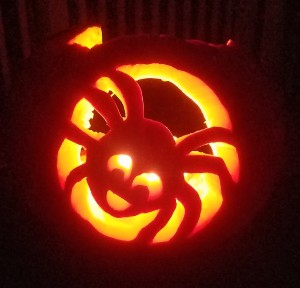
Last fall, I had been carving pumpkins on the walkway with my daughter. We put the “pumpkin guts” into a cardboard box to compost, but a few seeds must have slipped away and gone unnoticed by the dozens of mice/voles/chipmunks/whatever else ate most of my vegetable garden last summer.

So now, in a year when I didn’t plant a garden, I have the chance of at least a small crop.

It’s an apt metaphor. Our act of carving a pumpkin had repercussions beyond our knowledge. It’s the same with our actions. We may not see the stray seed that falls away and ends up sprouting underground, but it’s there nonetheless.

We can never be sure how our actions touch others, but we can rest assured that they do—sometimes in ways we expect, and sometimes in ways we could never predict.

Welcome to The Spot Writers. This month’s prompt: a cat stares at something behind its owner’s back. What does it see? (You can write the story from the cat’s perspective, if you wish!)

This week’s story comes from Chiara De Giorgi. Chiara dreams, reads, edits texts, translates, and occasionally writes in two languages. She also has a lot of fun.

One Historical Romance

by Chiara De Giorgi

My roommate, Jenny, loves to read historical romances.

Historical romances are basically love stories: out of eight hundred pages, at least six hundred are devoted to detailing hot intercourses and describing massive male chests and backs that are as vast as Greenland, but since in the remaining two hundred pages a king, a battle, a stronghold – or something of the kind – are featured, then they’re called “historical romances”. I also suspect the term “love stories” is widely despised.

So, anyway: Jenny loves those books. Recently, she’s seeking out all those that are set in Scotland, where the manlier men in the world apparently live: men that are so manly, they can wear a skirt! (The reason I know all these things, is that I normally sit next to Jenny while she’s reading, so as to peek at the pages and read along. Sure, sometimes I fall asleep, but that is normally not an issue, because when I wake up the hero and the damsel are still setting fire to the woods with their uncontrolled passion, just where I had left them.)

Sorry, I lost my train of thought.

A few nights ago Jenny threw a party. I really don’t like it, when Jenny throws a party. All those strangers prancing around the flat with their dirty shoes, claiming all couches and armchairs… it’s irritating. So, as usual, I stayed out of the way, half hidden behind a curtain. I was very still, and I scanned the crowd. I like to observe and deduce, I know things about people at first glance, that you wouldn’t believe. Once Jenny made me watch “Sherlock Holmes”: finally, a kindred spirit! Of course he had to be fictional.

Anyway. There I was, doing my thing, when he entered the room. I couldn’t believe my eyes. I stared at him from my hiding place, considering my options.

Suddenly, Jenny realized I was staring at something right behind her and she turned around. Damn it, now she was facing him, and her reaction was exactly what you can expect. She gasped and dropped her glass. He gallantly picked it up, while Jenny let her gaze slide all over his muscled body, his white shirt, and the sexiest kilt you can ever imagine. He looked like he had just jumped out of one of those historical romances, and Jenny was clearly determined to become his damsel. Could I allow such a waste of manhood? Of course not.

I quietly slipped out of my hideout and slowly made my way towards the two of them, keeping my eyes fixed right behind Jenny’s head – I know it creeps her out when I do that.

When I reached them, Jenny was flirting shamelessly and even shifted just enough as to conceal me from his sight. Unperturbed, I brushed up against his legs with a special technique of mine, tripping him up. He caught Jenny’s arm so as not to fall – not what I had wanted. But he had noticed me, and I knew he was mine.

He stroke me on my head and between my ears, baby-talking to me. “And who’s this beauty?”

I seized the moment and jumped in his arms, then I curled up against his formidable chest. Jenny was already defeated, but I lifted my eyes, stubbornly staring behind her head. There was nothing, of course, there’s never anything, but she doesn’t know that, does she?

The Spot Writers:

Val Muller: https://valmuller.com/blog/

Catherine A. MacKenzie: https://writingwicket.wordpress.com/wicker-chitter/

Phil Yeats: https://alankemisterauthor.wordpress.com

Chiara De Giorgi: https://chiaradegiorgi.blogspot.ca/

Welcome to the Spot Writers. This month’s prompt: “A cat always stares at something behind it’s owners back.”

Today’s post comes from Phil Yeats. Last December, Phil (using his Alan Kemister pen name) published his most recent novel. Tilting at Windmills, the second in the Barrettsport Mysteries series of soft-boiled police detective stories set in an imaginary Nova Scotia coastal community is available on Amazon.

The Moocher

by

Phil Yeats

The damn beast, a five-kilogram grey and black tabby that considered my yard part of its imperial domain, had returned. It snuck up to me slinking ahead in that crouching hunting pose characteristic of cats. Its gaze was intent on something behind me, a mouse or bird it stalked using me for camouflage.

I slowly turned my head peeking behind me at whatever the dumb animal sought. I saw nothing, I never did, and the blasted cat’s reaction never varied. When I made the slightest movement, it arched its back, its hair stood on end, and it hissed.

In the early days of this stupid feline game, I tried to wait it out, refusing to move a muscle. The effort was pointless. It could maintain its hunting crouch indefinitely. Eventually I’d twitch, and the damn thing would hiss.

I fetched it a cracker, Nabisco Triangle Thins were its favourite, and settled on my patio lounger. It licked the salt before crunching my offering leaving masses of crumbs for the birds and mice. Was it planning ahead, luring its unsuspecting prey into the open?

It hopped into my lap, turning about and kneading its paws the way cats do, before settling down for a nap. It would soon be purring quietly. Would it dream about the imaginary prey that never lurked behind me, or smugly consider how gullible I was, so easily tricked out of a cracker?


The Spot Writers—Our Members:

Val Muller: https://valmuller.com/blog/

Catherine A. MacKenzie: https://writingwicket.wordpress.com/wicker-chitter/

Phil Yeats: https://alankemisterauthor.wordpress.com

Chiara De Giorgi: https://chiaradegiorgi.blogspot.com/

 

Welcome to The Spot Writers. This month’s prompt: a cat stares at something behind its owner’s back. What does it see? (You can write the story from the cat’s perspective, if you wish!)

This week’s story comes from Cathy MacKenzie. Cathy’s first novel, WOLVES DON’T KNOCK, a psychological drama, is available from her locally or on Amazon.

MISTER WOLFE, the sequel, coming soon!

***

“The Visitor” by Cathy MacKenzie

We lock eyes. I know what’s behind her, but if I avert my eyes, she’ll realize something is wrong. She’ll freak.

Me? I’m in my glory, as they say. I want to pounce but can’t make a sudden movement or they’ll both freak.

One freakin’ female is enough.

She’s cute, though. Both of them.

I caught a look at the small one before human started staring at me. Maybe human knows. Maybe she’s forming a plan.

One of us needs to make a move.

Most likely, the human will move first. She’s the biggest. And I’m pretty sure she doesn’t know what’s behind her.

Why does she remain so still? Is she fixated by my smile? Does she suspect?

Or is she off in thought? She’s a writer, after all. She sits at her computer all day long, her fingers speeding across the keyboard as if there’s no tomorrow.

Or no today.

When she’s not there, I jump onto her desk and flake out on the keyboard.

I must look behind the human. She senses something. I sense she wants to turn around. I sense she’s scared.

Mice have sneaked into the house previously. I catch them and present them to her as if trophies. The same scenario will play out today.

I scamper across the floor, skidding on the smooth surface, and land where I want before the mouse has a chance to raise its dratted paw. I catch the silly thing, grip it with my teeth, and head to human. I drop it at her feet.

She screeches. She jumps up and down as if the floor’s on fire.

And screeches some more.

Then she’s quiet, rooted to the floor. Perhaps she’s afraid it’ll come back to life. It might. It’s only stunned. Not dead.

At that moment, Man Cave Dweller returns home.

She screeches at him. “Come here. Get rid of it. Catalina has brought in another.”

“Hush, woman. Hush.”

She screeches again and points to her feet. “It’s here, it’s here.”

He shakes his head, heads toward their bedroom, and returns. He’s changed into comfy clothes. He grabs food from the fridge.

“Can’t handle you, woman,” he mutters while descending the stairs to his cave.

She shrieks again. “You scumbag. Get back up here. Do your manly duty.”

I slither between her splayed feet and bound downstairs. Man Cave Dweller is unconcerned. He plays with the remote and minutes later, the big screen comes to life.

He soon snores.

I return upstairs. I slink from room to room, looking for the female human. Ah, there she is. Hard at work, as usual, on her computer. I bet she’s writing a horror story about mice that invade her home.

Oh my! What’s that by her feet? If I were a human, I would shriek.

Yep. I pounce.

Human shrieks.

I clutch mouse between my teeth.

Human woman and I lock eyes.

I dare you. Double dare, she seems to say.

***


The Spot Writers—Our Members:

Val Muller: https://valmuller.com/blog/

Catherine A. MacKenzie: https://writingwicket.wordpress.com/wicker-chitter/

Phil Yeats: https://alankemisterauthor.wordpress.com

Chiara De Giorgi: https://chiaradegiorgi.blogspot.ca/