Val Muller

The Electronic Wordsmith

Today I had the chance to interview C. A. MacKenzie. She’s a member of the Spot Writers, the group bringing free flash fiction to this blog for the last several years. Her novel, Wolves Don’t Knock, can be purchased at Amazon (click for link) or through her.

Tell us about yourself:

I’m a wife, mother, grandmother. I’m also a writer and published author.

Tell us about your book:

wolves dont knockWOLVES DON’T KNOCK is a psychological drama, with elements of thriller, mystery, suspense, romance, and family relationships. (It’s not a werewolf story!) Although it deals with sensitive issues (kidnapping and rape), there are no graphic scenes. The book is suitable for mature teens and up, geared for women of all ages. Despite that, I’ve had six males (that I know of) purchase the book and enjoyed it, which kind of surprised me.

WOLVES is my first novel. It’s told through the POVs of Miranda and her mother, Sharon. Miranda is kidnapped at the age of sixteen after giving birth to Kevin and escapes six years later. The first chapter deals with the kidnapping, but the rest of the book is about the year after she returns home. There are twists and turns. Both Miranda and Sharon have secrets they dare not reveal.  The kidnapper is still on the loose, too, so they’re looking over their shoulders, wondering if and when he’ll reappear.

Did you always know you wanted to be a writer?

It was never in my plans to be writer. I used to write when I was a teenager but didn’t really take up writing seriously until around 2010. After the births of my first two granddaughters in 2007, I got back into writing poetry. Short stories followed soon after, and I haven’t stopped since.

What is your “day job”?

Other than housework, travelling, and spending time with my grandchildren, I spend most of my day at the computer. I edit and publish other authors, too, so I’m pretty busy.

Who is your favorite character in your book, and why?

Sharon, Miranda’s mother, is my favourite character. As a grandmother myself, I relate to her more than a younger woman. Probably a little bit of me is revealed through Sharon’s words, actions, and thoughts.

Are any elements of your book autobiographical or inspired by elements of your life?

A couple of Miranda’s experiences are from my teen years. No, I’ve never had a child out-of-wedlock, so that isn’t one of them. And Sharon: some of her thoughts are mine. I won’t say which ones, ha ha.

What’s the strangest place you’ve ever been?

I found it eerie and scary. We were there twice, both for short visits, while cruising and travelling nearby. It was an intriguing place, though, very different, but I never felt comfortable there.

What’s your favorite scene or location in the work you’re currently promoting, and why?

I like the scene I wrote where Sharon is at Peggy’s Cove. There’s some deep stuff on those pages, and I also liked the description I portrayed. I hope the readers like it, too.

What book or author has been most inspirational for you, and why?

I enjoy Joyce Carrol Oates and have been told I write like her. I didn’t realize I did until another writer mentioned it; in fact, I hadn’t read any of her works until after he told me that. But that was a compliment, for sure.

If you were to be stranded on a desert island, what non-survival item would you bring along that you couldn’t live without?

My computer.

Are you working on any other projects at the moment?

I’m working on a (sort of) memoir about the death of my son, who died from a rare heart cancer last year. It’s been extremely hard working on it, but I need to finish it so I can move on, as I’m a focused person and find it hard to work on more than one thing at a time. I’m not sure yet whether this book will ever be “published.” It may be for my eyes only.

I also want to write MISTER WOLFE, the story of Paul Wolfe, the kidnapper in WOLVES DON’T KNOCK. I have most of the story played out in my head and if I can get it down on paper as I envision, it’ll be a terrific book (excuse my ego). It’ll be a stand-alone book but could be a prequel or a sequel to WOLVES. There are a couple of subtly-written passages in WOLVES that will be expanded upon that I am positive a reader of WOLVES will be totally blown away by. At least I hope so. This book will be much darker than WOLVES.

Find Cathy:

Cathy’s website/blog: www.writingwicket.wordpress.com
WOLVES DON’T KNOCK Facebook page: https://www.facebook.com/WolvesDontKnock/

When I was growing up, my dad used to call me by the dog’s name, the dog by my sister’s name, my sister by my mother’s name, and all sorts of other combinations. I thought he was insane.

Turns out, he was just a typical parent.

Now that I have young ones of my own, I can understand the brain misfires. I don’t know how many times I’ve referred to one of my kids as “Corgis!” or started to admonish one of the corgis using one of my children’s names.

Case in point. I recently had the opportunity to have a Moana party with my daughter–who is almost 3–from 3 a.m. until 7 one morning.

It started like this.

I woke at 2:55 a.m., just before the witching hour. It was still early for my son’s nighttime feeding, but my subconscious knew something was up. Wailing on my daughter’s audio monitor told me I was right.

I headed toward her bedroom, wondering what horror would confront me when I opened the door. A nightmare? Too hot? Something else?

“I puked!” she screamed, the voice echoing over the monitor and into the hallway. I cringed.

My nose immediately stuffed up. I think it’s one of my Mommy Powers. Any time she throws up, my nose stuffs up so that I literally can’t smell anything. I think maybe it’s evolutionary.

My mind raced with thoughts of what the next twenty-four hours might be like.

I got her in the bath tub and hosed her off, using the shower head attached to a long hose. Thank goodness for this shower head, I though naively.

Then fate laughed at me.

The diverter peg on the spout of the bathtub, the one that lets you switch to the shower head, broke off. Ker-plunk, into the tub.

“Son of a–”

“What, Mommy?” her innocent voice asked as she sucked back a lingering tear from her traumatic awakening.

The peg had snapped. There was no fixing it. My toddler’s eyes questioned my frustration.

“Do you feel sick?” I asked, trying to distract her.

“I’m not sick,” she said. “I just puked.”

She is two years old. I didn’t quite trust her capacity at self-diagnosis. My mind raced again. When she had the stomach virus at age 1, she was small enough to be placed on a towel and sleep until the next explosive wave. Would she be amenable now to being confined somewhere? Somewhere easy to clean?

“I’m not sick,” she insisted.

My mind raced with possibilities. I wondered how many times she would puke. I wondered whether I or my husband or the baby would catch it. I cringed, thinking about the “cookie game” she had played with us just hours earlier, passing a giant cookie around and having us all take turns having a bite. Surely we would all be sick. My mind and body prepared for a long night of cleaning and worrying about a sick child. And what if I got sick while she was still sick? And what if my husband got sick while we were both sick? Who in the world would take care of everyone?

I threw out the broken faucet peg and finished cleaning using buckets, dumping warm water over her head and hair in lieu of the shower head.

She looked up and smiled. “This is so fun!” she cooed as warm water from a bucket cascaded down her back.

I froze. My mind and body simultaneously relaxed and tensed. This was not the smile of a child sick with the stomach virus. This was the smile of a child who had awoken to a one-time sickness…and who was now wide awake.

At 3 a.m.

I finished cleaning her, and she splashed in the tub some more while I placed towels all over her mattress…just in case.

“I got your bed all changed and set up again,” I said. “I put towels on your bed in case you–”
She was already shaking her head. “I had a nice sleep,” she said, her smile growing. “But I’m awake now.”

I could see it in her eyes. She had hours of playtime in her. She was almost fully charged. Like a phone plugged in to 80%–a phone like that could last the whole day. I was nowhere near 80. I feared I’d doze off, no matter where we were.

“How about we camp out in the bathroom?” I asked. That way, if I fell asleep and she got sick, it’d be easy cleaning. “Pretend” camping is one of her obsessions, but my voice didn’t sell it well enough. “I mean, we could spread out towels, and make a pillow out of a rolled-up blanket, just like the cowboys do,” I said with more enthusiasm.

Her eyes remained skeptical.

“We can watch Moana,” I said.

Almost there.

“On my tablet.”

And I had her.

The first time we showed her The Nightmare Before Christmas, she literally screamed the whole time. “That’s Jack Skellington!” she cried in delight when he appeared. And when he was off screen, it would turn to “Where’s Jack? Where did he go?” It was the most challenging viewing of that movie, ever.
Moana was different. Safer. She’d always watched it silently. I set up a pillow and blanket for myself in the hallway and prepared to doze off.

She started out giggling and yelling at the screen. Then, at least every five minutes, she tried a new tactic. Did she know I was trying to sleep? Was she intentionally trying to engage me? Keep me awake?

Or is her subconscious a genius?

At least once every five minutes, she asked a question about a movie she’s seen more times than is healthy. The sad thing is, I’ve seen the film almost as many times, and I could answer her questions with my eyes closed.

“What’s that orange thing?” (A flower.)

“What’s she standing on?” (A boat.)

“What’s he having?” (A tattoo.)

Unfortunately, I could not answer in my sleep, so I had to stay up. For the entire film. Because she didn’t fall asleep. Not even a little.

After we made it through the whole movie and she didn’t fall asleep, I told her I’d better feed her brother. It was around 6 a.m., and although he didn’t always need to feed at that time, I wanted to be proactive, just in case it turned out she was actually sick. Better to feed a peaceful baby on my own terms. So, while things were calm, I told her to stay in the bathroom and relax.

If you have kids, you see the problem. I blame the number of hours I had been awake. If you don’t have kids, or don’t yet, I’ll give you a hint: you should never tell a toddler to just sit somewhere and relax. That’s like inviting a vampire into your home. Why would you do it?

I closed the bedroom door while feeding her brother, just in case she really was sick. It’s a well-known fact that doors keep out germs, right?

I didn’t hear any sounds coming from the bathroom, and although silence is terrifying in a toddler, I thought for sure she’d fallen asleep.

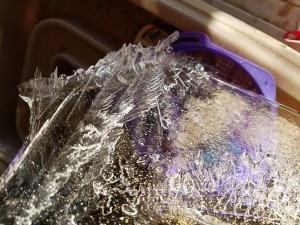
When I came back out she was doing what you see in the picture below. She had gone into the storage compartment of her step stool. Every single big hair tie she had placed around her wrist. Every single tiny hair tie she now wore around her fingers. And the medium sized ones were around several fingers like spider webs.

20181021_060038

Wild eyes of a toddler, or possessed by a demon? There are none who can tell.

I didn’t say anything, but she has become quite adept at reading my eyes. And my eyes asked, “What’s happening?”

She looked up at me with a deranged twinkle of passion in her eyes. And she said, “I don’t understand what I’m doing.”

The clarity of her response, coupled with very little sleep, coupled with the fact that it was absolutely true, and coupled with her very passionate facial expression, made me crack up uncontrollably. And then she joined in. And we were both laughing for like five minutes straight.

And that’s essentially why my dad always mixed up our names. And why parents look frazzled all the time. And why a man dressed as Frankenstein at a Halloween event recently told me he liked my costume—he thought “frazzled mother” was a good choice. It’s that toddlers simply act, and even they don’t know why they do it.

As a mentor of mine once said, just try to live in the moment, take a step back from it, and enjoy the “free entertainment” while it lasts.


Welcome to The Spot Writers. This month’s prompt: a book keeps appearing out of the blue in the most unexpected and unusual places.

This week’s story comes from Cathy MacKenzie. Cathy’s novel, WOLVES DON’T KNOCK, is available from her locally or on Amazon, to great reviews.

***

The Notepad by Cathy MacKenzie

“Bob, did you see my book?”

“What book?”

“The one I was reading. I had it a few minutes ago.”

“Which one was that?”

Candace and Bernie,” I shouted back, exasperated. “Did you see my book or didn’t you?”

“Nope.”

“I had it a few minutes ago.”

“Don’t know. Haven’t seen it.”

Was I losing it? Books I had been reading had mysteriously disappeared over the last little while. Is this what the Golden Years bring us seniors? Sure, I was forgetful but no more than the average person; at least, I didn’t think so.

I’ve lost other things in the past, like my reading glasses, only to find them perched on top of my head or dangling from the beaded chain around my neck. One time I found them on the bathroom counter, where I’d forgotten them after plucking that unsightly and hard-to-grasp silvery, spidery hair from my chin.

And then there were the car keys. Easy to misplace those. Voila, they turned up on the foyer table even though that wasn’t a place I’d ever leave them. I’m always extra careful to put my keys back into my purse because I’ve returned into the house too many times after forgetting them on the kitchen counter. Once, after looking for hours, I found them in my coat pocket.

But this missing book was another matter, one far removed from the usual, everyday age-forgetfulness. Math has never been my strong point, but this particular book has been lost at least six times—all during the past week. Was dementia setting in faster than expected? And was it dementia—or something worse?

I was into the third chapter earlier in the week when it first went missing, but I later found it in the guest bedroom. The next time, I discovered it in the closet in the side porch. I’d never leave a book in those places, let alone read there, so I was mystified. The third time, it turned up in the refrigerator. I wasn’t aware the book was missing then and had breathed a silent prayer that Bob hadn’t found it first. What would he have thought?

The other places were just as silly. Stupid, silly places.

And now, missing again, and I was positive, as I’d always been, that I had left it by my chaise lounger in the living room.

I sauntered to the bedroom and plopped to the bed. Tears cascaded down my face. Too many instances of misplaced objects lately, and I was sick of Bob nattering at me about being so forgetful. He had put his mother in a home when she developed Alzheimer’s. “I can’t handle her anymore,” he had said. He was an only child; there was no one else. I offered to take care of her since I was home all day, but Bob wouldn’t hear of it. “She has plenty of money. She can afford to go to a home.”

Stashing a human away, never again to see the light of day, was cruel. And everyone’s heard horror stories about those places. Bob’s promised daily visits turned into weekly visits that soon morphed into monthly. The month before she passed on, visits had become almost non-existent. Bob seemed grateful at the end as if he’d been absolved of guilt. And duty.

Would Bob do that to me? I’ve always dreaded going into a senior’s home. We’d made a pact when we married thirty years ago that we’d never do that to the other. Instead, we’d care for each other in sickness and in health—‘til death do us part.

But if I were losing my mind? What then? I’d eventually be unaware of my surroundings, and Bob could easily deposit me in one of those institutions. Without a functioning mind, how would I know?

I dried my tears and picked up the phone. I must see my doctor. Luck was on my side. She had an opening on Monday. I didn’t tell Bob. No sense worrying him. He wouldn’t know anyhow; he’d be at work.

Four months until he retired. We’d enjoy the good life then, travelling, dining out, enjoying each other’s company. Bob was excited and eager for that day.

“Did you find your book?” he asked when I returned to the kitchen.

“Yes.” For the first time in my marriage, I lied to my husband.

Minutes later, I found it in the laundry room on top of the dryer.

Hours later, while trying to concentrate on Candace and Bernie—a not-so-happy life for either of those fictional characters—I devised a plan. I’d keep a small notebook in my pocket and when I finished reading, I’d jot down where I left my book. That way, I’d easily find it. Bob would be none the wiser.

The plan seemed ideal to me (as long as I remembered I had a notepad!), yet I shivered despite the hot summer day. Is this what my life had reverted to? Losing one’s mind wasn’t pleasant.

Bob seemed distant in bed that night. When I questioned him, he claimed work issues. I returned to my side of the king-sized bed.

On Monday, my doctor assured me I was fine. “Advancing years,” she said. “I’ve experienced the same issues.” She was ready for retirement, too, but I bet she hadn’t experienced missing books that turned up in odd places.

When I returned home, I decided to start the week fresh. A new week. A new notepad.

The notepad didn’t help. Most of my days were wasted while I continually searched for my book. I felt like a child hunting for Easter eggs. I didn’t get much reading done. But I knew one thing for certain: I wasn’t going crazy; I hadn’t lost my mind. But what was going on?

And then, mid-week at noon (Bob always came home for lunch), I caught him scurrying off with my book. 

Aha! The mystery was solved. But why?

The next evening, I followed Bob when he was purportedly going to the Silver Seniors’ Centre down the road. Supposedly, guys played crib there once a week. 

But he didn’t go to the Seniors’ Centre. 

And then it all made sense. He wanted to get rid of me, probably wanted to commit me to an insane asylum (did such institutions still exist?) or, at the very least, toss me into a home as he had his mother. If it weren’t for my trusty notepad, I’m positive I would have turned into a crazy.

Yep, you guessed it! (Didn’t you?) Bob, my dear sweet (ahem!) husband, was experiencing itchiness.

Bob had found a young thing to cavort with. 

I immediately transferred half of our investments into my name, cleaned out our joint bank account, and left him to his sweet honey. He never contacted me. He knew I had the goods on him, so to speak.

I don’t know what he’s doing now, but I’m enjoying my books in my solitude. And they don’t go missing any longer!

Mwahahaha!

***

 The Spot Writers—Our Members:

Val Muller: https://valmuller.com/blog/

Catherine A. MacKenzie: https://writingwicket.wordpress.com/wicker-chitter/

Phil Yeats: https://alankemisterauthor.wordpress.com

Chiara De Giorgi: https://chiaradegiorgi.blogspot.ca/

IMG-PHOTO-ART--862596981This Halloween begins with a weird anecdote.

On more than a few occasions, my two-year-old daughter has seemed to read my mind. I would be thinking about something completely unrelated to what we’re doing, and without warning she would ask a question about or mention something related to my thoughts.

Something strange happened the other night. I was watching the new series The Haunting of Hill House. After my toddler went to bed, of course. She was up in her room, and we were in the (finished) basement.

Without spoilers: the episode contained a scene of a kid in a basement confronting a terrifying sight. This was one of only three scenes that has ever truly terrified me. The first: a scene from Star Trek: The Next Generation, in which a doctor who hasn’t had REM sleep in ages imagines she sees a room full of wrapped corpses sit up simultaneously. The second was from a movie called Boogeyman, and in it, a mass of shadows (created from innocuous objects) transforms into a boogeyman. I guess my fear is ordinary things transforming into terrifying ones.20181031_215342

Anyway, while watching Hill House, I became so “on edge” that my dog even jumped on my lap. He only does this is he’s cold (he wasn’t), if it’s thundering (it wasn’t), or if the smoke detector low battery is chirping (nope). I guess I was putting out “vibes of terror.”

The scene truly was my worst childhood nightmare. If I had watched it as a kid, I would never have been able to sleep. At the peak of my terror, my daughter started screaming through the monitor. This is something that happens once in a blue moon. She’s old enough that if she wakes up and needs something, she simply asks, as she’s aware we can hear her through the monitor.

This was not the case. She was simply crying and screaming. I dashed up two flights of stairs to see her standing in the middle of her room, fists clenched and tears running down her face. I asked her what was wrong, and she told me that something scared her. She could articulate no more than that.

I’m fairly sure she picked up on my vibes and had a nightmare as a result. Her screaming perfectly coincided with the height of my fear.

My family has had a long history of having weird “connectedness.” We’ve had premonitions and dreams, including dreams that coincided with each other. It’s happened enough to convince me that it’s not a coincidence. There is a connectedness that transcends the ordinary world.

It’s a theme I tackle in my novel The Man with the Crystal Ankh. In the novel, characters forge connections that last even after death and across various levels of consciousness. It’s part of why we celebrate Halloween—the glimpse at the line between life and death, a line that sometimes seems less than definite. I like to think our consciousness lives on in one form or another, whether between and among people in this world, and between this world and the next.

This Halloween season, I’ve been to several “trunk or treat” events and witnessed the togetherness of gatherings and celebrations and parades. I’ve smiled at a family pumpkin carving party and laughed while creating a pizza jack-o-lantern. This spooky time of year, when the veil between the living and the dead is at its thinnest, is perhaps the perfect time to celebrate all that makes our lives special.

Each other.

The current prompt: News these days contain a plethora of depressing stuff from floods and wildfires and other environmental problems, to mass shootings, to refuge problems and other political and social crises, to whatever you like as your favourite example. Write a story focused on one or more of these depressing occurrences and give it a happy ending.

This week’s story comes from Chiara De Giorgi. Chiara dreams, reads, edits texts, translates, and occasionally writes in two languages. She also has a lot of fun.


If you can’t kill it, make it your friend

by Chiara De Giorgi


Up to 60% of the human body is water. If left without water, a human being dies in three or four days. That’s seventy-two to ninety-six hours. Plants die: a desert is what you have when there’s no water. No water means nothing alive. Water is life.

But water is death, too.

Have you ever noticed how many times water is involved in a natural disaster? Floods, heavy rains, hurricanes, tsunamis… Water can save you from burning in a fire, but then water can freeze and kill you with hypothermia.

After losing friends, family, and belongings to water, in one form or another, more than enough times, I realized I hated it. And yet, the supremely annoying fact was, I couldn’t live without it. I felt helpless when, during a torrid summer, all I could dream of was a lake of crystal clear water to dive into; a frothing waterfall; an iced glass of pure water.

Water had become an obsession. I feared it, I craved it.

I spent years researching ways to survive without this hateful dependency on water, trying to figure out a way to substitute it with something, anything else. I even went so far as designing living beings that were not carbon-based, thinking that maybe it would be possible to operate just a small genetic modification on humans, to make them not water-dependant.

It didn’t work, nothing worked. I was left sad, frustrated, empty-handed, and alone.

Then one day I woke up with a totally different strategy on my mind: if you can’t kill it, make it your friend.

If I could not come up with a way to survive with no water, I’d come up with a way to survive too much water.

My studies changed direction: no more chemistry, biology, and genetics. I turned to myths and folklore.

When I felt ready, I moved to Maldives. There are often hurricanes and tsunamis there, lots of unexpected water, and it’s a lovely place when the weather’s good.

When the rain started falling, and the wind started blowing, and the earth started shaking, and the waves started climbing towards the sky, I was there. While everybody was fleeing to the backland, I ran to the beach. While everybody was wearing a raincoat, I stripped down to my bikini. While everybody screamed for help, I let out a triumphant cry and dove.

See, I am a mermaid, now. Too much water will never kill me, and I’ll never suffer from the lack of it, as oceans are limitless and everlasting. I won’t ever lose my friends and family to water, and it will never steal my belongings again. I won. If you can’t kill it, make it your friend.


***

The Spot Writers – Our Members:

Val Muller: https://valmuller.com/blog/

Catherine A. MacKenzie: https://writingwicket.wordpress.com/wicker-chitter/

Phil Yeats: https://alankemisterauthor.wordpress.com

Chiara De Giorgi: https://chiaradegiorgi.blogspot.com/

For this week’s Writer Wednesday, I’m happy to feature M. H. B. Hughes, author of 1777–Danbury on Fire! I was fortunate enough to help Millicent with the editing and layout of the novel, and the book has special meaning to me because (1) it takes place in the area of the country in which I was raised and (2) it’s about freedom and its variations, one of my favorite themes.

You can learn more about the author at https://www.danburyonfire.com and purchase your copy here.

I hope you enjoy the responses Millicent provided regarding her novel and the research involved:

coverTell us about yourself: When I began the book seven years ago, I was commuting almost four hours per day, while considering how to intertwine characters and reality. Much of the story came from fact, some from probability: if you were XXXX, what would you do? I often felt astonished when research proved the reality of my theories. Even up to the very end, I discovered new information to incorporate before someone could catch me out on historical fact.

Tell us about your book: Joe Hamilton, 13, is shocked when his attempts to become a tavern kitchen boy seem thwarted by politics. Powerful relatives reject Joe’s parents until they come around to the Patriot view. Joe believes his father is on the edge mentally, but physically as well: a family “investment” is a handsome stallion now turned vicious. Joe’s delightful hero, Lambert Lockwood, wanders through the plot ─ until he meets a bullet in embarrassing circumstances. Joe’s desire to help his friend is thwarted by finding helpless relatives in immediate danger of death. Soon enough, Joe fears for himself when a British trooper acts way too friendly. Stakes rise with the flames as Danbury goes up in smoke.

Did you always know you wanted to be a writer? Most of my characters were real people and were my relatives and their friends: I feel that they wrote my book by channeling through me, although Lambert Lockwood and J. S. Cannon were the only ones channeling. I used to believe that I could hear a woman’s voice, pleading, “But I was a real person: I had a real street address!”

Who is your favorite character in your book, and why? The more I learned about the real Lambert Lockwood, the more I fell in love with this handsome man (“of good appearance,” according to one source). His horrific experiences at the loss of Fort Washington led him to combine with Danbury town lawyer Tad Benedict to start a Masonic lodge, because all Masons vowed to assist each other. After the war, Lambert followed into the hardware business, moving to Bridgeport CT, where he added a book printing shop to supply his bookstore and lending library. Lambert retained the childlike enthusiasm and hardheaded awareness that he displayed in the book, financing his sons in selling the first imported board games and children’s toys in New York. He backed the first bank and the first insurance company, as well as the first Masonic lodge in Bridgeport. The final public scene in his life is mentioned in the book, the crowning reward to a life well lived.

What’s your favorite scene or location in the work you’re currently promoting, and why? I like the early dinner party scene, as the mother returns to her real personality, before the war in the family robbed her of her of her own beliefs. A mini-infatuation of Joe’s would-be girlfriend with a handsome British face makes me remember thirteen all too well. The British officers (except for one) are portrayed as pleasant and well-intentioned, although sometimes they reveal a little & more….

 What book or author has been most inspirational for you, and why? Gigi Amateau’s Come August, Come Freedom and Bob O’Connor’s The Perfect Steel Trap showed me ways to combine fiction and reality. Gigi put letters into her book, which gave me the “Yes!” moment for including snips of documents in 1777. Bob O’Connor’s The Perfect Steel Trap uses masterfully imagined letters/depositions from those involved in the Harper’s Ferry fiasco.

If you were to be stranded on a desert island, what non-survival item would you bring along that you couldn’t live without? Coffee, for sure! A couple of cups and I could just swim home, right?

Are you working on any other projects at the moment? Yes, two.

  • Looking for an illustrator for my chapter book Pet Care 101 about the unwelcome arrival of two ferrets in the home of twins who really wanted a dog. (Illustrations must be realistic, not cartoons.)
  • The other book Horses+Boys≠School visits young equestrians. Ambitions and faults collide as each searches out the niche for which they qualify. Foremost is Leah, 16, overmatched in school as well as in love, where she is partnered, but not romanced by Turk, a boy on the rebound, who wants a trophy to show off. On the sidelines watching is the brilliant Char, the rejected former girlfriend, now a lioness on the prowl, just waiting the chance to claw her rival.

What question do you wish I had asked?

“For what age group is your book intended?”

I think of it as ageless, because of facts that pose new questions to the reader. What are artificers or cradles? What part did religion play in the war? With what attitude did the English try to stop the rebellion?  I injected a little modern snarkiness on all sides, à la Mark Twain, because persons in those days had the same feelings as modern folks!

(I recently purchased a Newbury winning book from 1957 Rifles for Watie, ostensibly a YA, yet I loved its revelations about the Civil War in Arizona. Who knew that Indians fought in the Civil War?)

Finally, where can we find you?  https://www.danburyonfire.com or Millicent Bell Hughes on Facebook (where you see a lot of extraneous horse stuff)


Last week, the Toddler Tuesday post featured words the toddler makes up or combines to make sense of the world. Here is a video she helped me make to demonstrate the word “fluffly.”

My daughter’s first television show—at least, the first one that captivated her attention—was Peppa Pig. It was recommended by my husband’s coworker, and it was literal love at first sight.

The moment the toddler discovered Peppa Pig. I fear no human on Earth will warrant a more perfect love at first sight.

The moment the toddler discovered Peppa Pig. I fear no human on Earth will warrant a more perfect expression of love at first sight.

Since then, we have watched every episode countless times. I could probably recite several from memory, and I couldn’t tell you how many times I’ve referenced something from Peppa Pig in explaining things to the toddler.

“Mommy, what’s that?” she might ask.

“That’s construction equipment,” I’ll say.

She’ll shoot me a perplexed look, telling me she doesn’t quite understand.

“You know Mr. Bull on Peppa Pig?” I’ll ask. Her eyes will light with understanding. “The equipment there is similar to what Mr. Bull uses to build houses.”

“And dig up the road!” she adds, nodding understandingly.

But another fun side effect of her obsession with Peppa Pig is that it’s British. So, many of the terms we use for common objects here in American are referenced differently in the show. As a sampling, the toddler now refers to her flashlight as a torch. Our yard is a garden, even though our tomato garden is also a…garden. Many things are “lovely” instead of “nice” or “good.” When I show her pictures of our beach vacation, she references the time we “went on holiday.” As for nap-time, she often says she is “a bit tired.” When people thank her, she tells them, “you are most welcome.”

When I mix something in a bowl, like pancake mix or cake batter, she says she must “make a wish” over the “Christmas pudding.”

British English here in America has the effect of seeming a bit formal, so it’s sometimes comical coming from a toddler. Going on a walk at dusk, she might say, “I need to find my torch because it’s a bit dark” and she’ll need a jacket because “it’s a bit chilly.” Or if she wants us to turn on the light in her room, she might say, “Mom, I’m a bit scared.”

But the most humorous element of her obsession with Peppa Pig is her pronunciation. She has adopted a British pronunciation of several words, and I’ve noticed she switches from time to time between American and British pronunciations, sometimes even within the same sentence.

But one word stands out. The abbreviation for “cannot,” “can’t” has stuck with her as British in nature. I’ve noticed that many of the “child” characters on Peppa Pig say, “I can’t” quite frequently, as in “I can’t reach.” My daughter has picked this up.

The effect is a toddler speaking very formally, in an overly-dramatic nature.

“Get your shoes on,” I might say.

She’ll look at me with a very serious expression. “caaaan’t,” she’ll say, drawn out and slow and politely British. “They’re the tie kind.”

The way she says it makes the whole ordeal seem that much more dramatic than it should, as if I’ve just asked her to marry her mortal enemy (“I simply caaaan’t.”). I could see her throwing her hand across her forehead as if ready to faint. The way she says it makes it seem like every fiber of her being is ready to give up its very existence if it is forced to take one more step in the requested direction. But when applied to everyday situations, the result of the juxtaposition is humor:

“Please eat the last bite of your broccoli.”

“I caaaan’t, I just caaaan’t.”

“Time for you to go to bed.”

“I caaaan’t, mommy.”

She needs a formal dress, I think, and maybe a tiara. Then maybe I would believe her.

And I need to learn more effective ways of biting my tongue to stifle laughter.

“Honey, can you please stop hitting the keyboard so mommy can finish this blog post?”

“I caaaan’t, Mommy. I just caaaan’t.”


Welcome to The Spot Writers. This month’s prompt: Newspapers and news sites show a plethora of depressing stuff from floods and wildfires and other environmental problems, to mass shootings, to refugee problems and other political and social crises. Write a story focused on a depressing occurrence and give it a happy ending.

This week’s story comes from Cathy MacKenzie. Cathy’s novel, WOLVES DON’T KNOCK, is available from her locally or on Amazon, to great reviews.

***

Downtown Meetings

by Cathy MacKenzie


“Did you go downtown this morning?” Simon asked, entering the kitchen.

I jerked around from the counter, dropping the dishtowel as I did so. “Why?”

“I saw you driving down Main Street with the top down.”

The top down? I breathed a sigh of relief. “Nope, not me.”

“It sure looked like you.”

“You know I never have the top down when I’m alone.”

“And why is that?”

“Because it’s presumptuous. Like I’m flaunting. You know I hate attention.”

He laughed. “Well, it looked like you.”

“When did you think you saw me?” I bent over to pick up the towel, glad to have something in my hands.

“Oh, I guess it was around eleven or so. I had to go to a meeting on Churchill.”

“Wasn’t me. There’s lots of red mustangs.”

“Yeah, I know.” He wrapped his arms around my shoulders and kissed me. When he broke away, he asked, “What’s for dinner?”

“Meat loaf.” Simon’s favourite.

After dinner, he disappeared downstairs to his man cave.

I plonked to the kitchen chair. Scary stuff, that was. Had he seen me in my red Mustang with the top up, trying to catch me in a lie? No, he had no inkling.

My life was simple and carefree, with very few problems as compared to those who endure such catastrophes as forest fires, tornados, and hurricanes. Why did I want to create a disastrous situation when there was no need for one? Simon was a perfect husband and provider. Sure, we had the odd spat—what married couple didn’t? I should be more grateful for him and my life.

I finished the dishes and headed to the bedroom, intending to read in bed. Instead, I pondered, unable to concentrate on the book. Sweat poured over me, and I threw off the blanket. What had I been thinking? Could I have gone through with it?

If Simon had actually seen a woman resembling me in a car similar to mine, what a cruel coincidence. I very rarely drive downtown. What a fluke he’d been there the same morning I was.

I hadn’t been attracted to Rob, not with his receding hairline, paunchy belly, and seventies-style clothing. Not up to my standards, for sure, and I should have exited the mall immediately when I saw him—the guy who waited by the fountain. Despite my initial reaction, we enjoyed conversation over lunch. I was taken aback when he mentioned his wife and how it would kill her if she discovered he’d been hooking up with other women.

Gee, what should he expect? He had joined Dates & Mates, a local dating site, specifically for sexual partners. It would kill Simon, too, if he ever found out I was a member. But this was my first time. Rob was the first anonymous guy I’d connected with online, the first guy I’d met in person.

“She never wants it anymore,” Rob had said. “She has a condition.” He rattled off the medical term, which was foreign to me.

I had almost blurted, “So, because she can’t—or won’t—engage in sex that gives you permission to seek sex elsewhere?” But I kept my mouth shut. Who was I to talk? I was as bad as he was.

I wondered what sort of marriage Rob had, and that’s what had knocked the sense into me, thinking of his innocent, unsuspecting wife at home, waiting for her husband, not knowing of his double life.

This was all foreign to me. Cheating and lies. And what about my love for Simon, my husband of ten years? Didn’t he deserve better? I had thought I needed excitement in my life, but I already had the best husband. I didn’t want another. It was pure luck Simon hadn’t caught me.

Suddenly, I was cold and yanked the covers over me. Minutes later I heard Simon coming up the stairs. He would keep me warm, as he always did.

***

The Spot Writers—Our Members:

Val Muller: https://valmuller.com/blog/

Catherine A. MacKenzie: https://writingwicket.wordpress.com/wicker-chitter/

Phil Yeats: https://alankemisterauthor.wordpress.com

Chiara De Giorgi: https://chiaradegiorgi.blogspot.ca/

I remember in school, English teachers loved to tout the fact that Shakespeare made up words when he couldn’t find one to suit his needs. Some used it to argue for Shakespeare’s genius. Others seemed to want to make students feel better when creating a word of their own. I often remind myself of this when listening to my toddler speak.

IMG-PHOTO-ART-1541202197As my pediatrician explained, my toddler has advanced speaking abilities, stringing together paragraphs at a time like a kid twice her age. Only, she still has the maturity of a two-year-old. So listening to her speak is often, um, entertaining. Yes, we’ll call it that.

Today, for your entertainment, I present a Toddler Tuesday post. The first several will be dedicated to her language use and the resulting hilarity. Today’s post is all about vocabulary. When the toddler hears a new word, she often associates it with something familiar. The results are amusing.

Momitor. Derived from the English “monitor,” this device is “the thing mommy uses to listen to me when I am supposed to be napping.”

The ele-gator. A cousin of the alligator, the ele-gator opens its mouth at the push of a button to devour small children and their parents, delivering them from one floor to another.

Bu-meat-o. A breakfast bu-meat-o is a thing toddlers like to eat containing breakfast and meat. Duh.

Too fit. You might think this is literal, as in “mommy is too fit, brother, from chasing us around the house” (I wish). But you’d be wrong. The phrase “too fit” is used when something doesn’t quite fit correctly. Sleeves too long? They are too fit. Pants a bit snug? They, too, are “too fit.” Talk about language efficiency: this phrase allows a tantruming toddler to complain about any number of issues regarding her clothing without being bothered by pesky and practical details.

Fluffly. We’ll end this post on a cute note. This word is a portmanteau of the words “fluffy” and “lovely.” A fluffly toy is a cuddly toy, such as a bear, that also happens to be lovely. So, a bright rainbow plush bear is fluffly, as is a cuddly puppy with a heart embroidered on its chest. A fluffly toy is essential for long car rides, tantrums, naptime, and bedtime, as well as other traumatic events such as when your mommy gives you the wrong color fork at lunch. As in, “I need my RED fork, mommy, and now I need a fluffly toy to cuddle.”

She’s so serious about it that most of the time I end up turning my back to hide my chuckles. And hopefully I shared a few with you.

Welcome to the Spot Writers. Today’s post comes to us from Val Muller. She’s the author of the Corgi Capers mystery series (www.CorgiCapers.com) among other works.

The prompt: News these days contain a plethora of depressing stuff from floods and wildfires and other environmental problems, to mass shootings, to refuge problems and other political and social crises, to whatever you like as your favourite example. Write a story focused on one or more of these depressing occurrences and give it a happy ending.

The Cabin

by Val Muller

It was his grandfather’s legacy, something he built by hand with old-school craftsmanship, something they didn’t even really teach anymore. As a kid, grandfather’s cabin had always felt more like a bomb shelter to Ryan in that it seemed indestructible. Its worn wooden boards were solid as the Earth. Its door could take a battering from any kind of weather. Visiting the cabin was a perpetual camping trip, a constant game of fetch, an unending wilderness retreat.

As a teen, the cabin sheltered Ryan in a different way. It was impervious to bullying and breakups, to failed chemistry tests and college rejections. Like Walden, it promised a retreat from the monotony and fatigue of life. There was always a fishing trip to be taken, a stroll to be had in the woods, a fire to be built in its stout little potbelly stove. It had been a place for grandfather to bestow his ancient wisdom, and a place to remember the old man after he had passed.

But not even grandfather’s cabin could withstand the forest fire. Ryan was lucky he got out alive. He’d been there not twenty-four hours before the whole forest was put under mandatory evacuation. He left without a sight of fire, with only the faintest scent of smoke on the wind. He read later that a father and son on a mere two-hour hike had gotten stuck in the fire and perished just yards from a pond that might have saved their lives.

Yes, Ryan was lucky to have left alive. Now, he returned to a smoldering world, a post-apocalyptic one worse than the most painful breakup or the most misunderstood unit in chemistry. He followed the gravel trail there in his off-roader; the remains of the trail were the only sign that he was in the right place. The cabin, tiny in the dense forest, had been nothing for the fire to consume. A mere side dish for its insatiable appetite.

There, in the ashes, stood the stone steps grandfather had stacked himself, still mostly intact. And in the corner of what used to be the cabin, the potbelly stove, black as ever and the only thing that seemed remotely okay to have witnessed such flames, next to a charred chimney.

“I’m sorry, grandfather,” Ryan whispered. He remembered his grandfather’s words, the ones repeated in the will and testament. Take care of the cabin as I did and bequeath it to your children’s children.

Now, there was no cabin left to bequeath. How long did it take forests to recover from such fires? The trees stood around the razed cabin like charred matchsticks. A bit further away, green undergrowth peeked out of the ashes, and several lines of trees seemed untouched. The path of the fire hadn’t taken everything–but it had come straight for the cabin.

The undergrowth seemed to sway in the windless day. What was that? A draft?

No, something else.

Ryan stepped closer. Something brown peeked out of the growth. A coyote? Did those even live around here? A bear cub?

Whatever it was, it looked half dead. It approached on cautious, shaky legs.

A dog?

Ryan blinked. For a moment, it almost looked like the ghost of Blue, grandfather’s favorite dog. Ryan remembered the German Shepherd Dog as a kid. Blue would always be the quintessential dog in Ryan’s mind. Fetch-loving, tail-wagging, bone-chewing Blue.

Yes, it was definitely a dog. Ryan reached into his pocket, pulling out the only thing he had to offer, a granola bar. He unwrapped it slowly, and the dog sniffed, its tail wagging between its legs.

“It’s okay, Boy,” Ryan said, offering the bar.

The dog’s tail raised, and it approached. It made eye contact briefly, then grabbed the granola bar and retreated a few feet to consume its prize. Finished, it looked at Ryan expectantly.

“I have water in the car,” he said.

The dog sat, tail wagging, clearly domesticated.

Ryan tipped the bottle of water into the dog’s mouth, and it lapped at the stream greedily. Ryan noticed it had no tags. No name. No home. He’d read about the animals displaced from the fires. People were setting their animals free in hopes they would save themselves–horses, livestock, dogs, cats… with only moderate chance of being reunited with loved ones. The scope of the fires was simply too much. This dog was one of its victims.

“One less victim,” Ryan whispered, looking at the cabin again and noticing its foundation easily traceable in the ashes.

“Come on, Blue,” he told the dog, jingling his car keys. “Let’s go home.”

*

The Spot Writers—Our Members:

Val Muller: https://valmuller.com/blog/

Catherine A. MacKenzie: https://writingwicket.wordpress.com/wicker-chitter/

Phil Yeats: https://alankemisterauthor.wordpress.com

Chiara De Giorgi: https://chiaradegiorgi.blogspot.ca/